A reading log printable turns a vague wish to 'read more this year' into a habit you can actually see building, one book at a time. You write down every title you finish, rate it, note the dates and format, and watch your books-read list grow longer month by month. That visible progress is exactly what keeps readers picking up a book instead of doom-scrolling on the sofa. If you keep meaning to read more but somehow never do, the right reading journal is the simplest first step.
Want to read more this year? Our digital reading journal lets you log every book, rate it and track your challenge—use it on your iPad or print it at home and start your first page today.
 Shop 90 Day Goal Planner →
What Is a Reading Log Printable?
A reading log printable is a page (or set of pages) where you record each book you read—title, author, the dates you started and finished, the format and a star rating. Most also leave room for a one-line review or favourite quote, so the log slowly becomes a little memory keeper of your reading year. Unlike a half-remembered mental list, a written reading log template gives you one tidy place to see everything you've finished and everything still waiting on your shelf.
A good reading log helps you:
- See every book in one place instead of forgetting what you've read.
- Keep a clear books to read list so you always know what's next.
- Spot your patterns—which genres you love and which you keep avoiding.
- Stay motivated with a visible, satisfying record of progress.
It's also a brilliant accountability tool. Because the log is right there on your desk or in your bag, your reading goal stays front of mind in a way a vague resolution never will. Plenty of readers keep theirs by the bed or stick a colour-in challenge chart on the wall—every time they walk past, it's a gentle nudge to read a chapter before bed. That daily reminder is a big part of why a reading tracker helps people actually finish more books.
Why tracking helps you read more
It sounds almost too simple, but the act of logging changes your behaviour. When you know you'll write the book down and rate it, you read a little more deliberately—and a little more often. Seeing the list grow becomes mildly addictive in the best way, and it stops half-finished books from quietly vanishing. A log also helps you abandon books guilt-free: if something isn't working after fifty pages, note it and move on. Life's too short for a book you're not enjoying, and your tracker frees you to keep momentum rather than stall.
What to Record in Your Reading Log
You don't need to write an essay for every book—the magic is in keeping it quick and consistent. These are the details most readers find worth logging:
- Title and author—the basics that make your list searchable later.
- Start and finish dates—so you can see your pace and your reading streaks.
- Format—paperback, ebook or audiobook; it all counts.
- Star rating—a quick gut-feel score out of five.
- A one-line review—a single sentence you'll thank yourself for at year-end.
Add a genre tag if you enjoy spotting patterns, and a 'favourite quote' line if you like collecting words. The goal isn't a perfect record; it's a habit light enough that you'll keep it all year.
 Shop Ultimate Planner Mega Bundle →
Popular Reading Challenges to Try This Year
A reading challenge gives your log a target to aim at, which turns reading from 'something I should do' into a game you're quietly winning. Pick whichever suits the season of life you're in:
- A book a month. Twelve books a year, gentle and achievable—perfect if you're rebuilding the habit.
- A book a week. Fifty-two books a year for committed readers; audiobooks count and help you hit it.
- A genre challenge. Read one book from a different genre each month to break out of your comfort zone.
- Clear your TBR. Work through that to-be-read pile that's been judging you from the shelf.
- A page goal. Aim for a yearly page count instead of a book count—kinder to chunky-novel lovers.
Whichever you choose, write the target at the top of your log so it's the first thing you see. A challenge you can see is a challenge you'll chase.
A sample genre reading challenge
If you fancy mixing things up, here's a simple month-by-month genre challenge you can copy straight into your log:
| Month | Genre or prompt |
|---|---|
| January | A book that's been on your shelf longest |
| February | A romance or feel-good read |
| March | A non-fiction or memoir |
| April | A book set in another country |
| May | A mystery or thriller |
| June | A book recommended by a friend |
Repeat the pattern through the rest of the year, swapping in genres you'd normally skip. By December you'll have read far more widely than you would have on autopilot—and your log will prove it.
How to Use Your Reading Log
Getting started takes one short sitting:
- Set your challenge. Decide on a book a month, a book a week or a genre run, and write it at the top.
- Build your books to read list. Jot down five or ten titles you're excited about so you never stall on 'what next'.
- Log as you go. Each time you finish a book, fill in the title, author, dates, format and rating while it's fresh.
- Add a line of thoughts. One sentence is plenty—your future self will love it.
- Review monthly. Glance back at your progress, celebrate the wins and tweak your TBR.
That's it. Five minutes a book is all it takes to build a record you'll treasure—and a habit that quietly makes you a reader again. If you like pairing reading with bigger ambitions, a 90 day goal planner is a lovely companion for setting a quarterly reading target alongside your other goals.
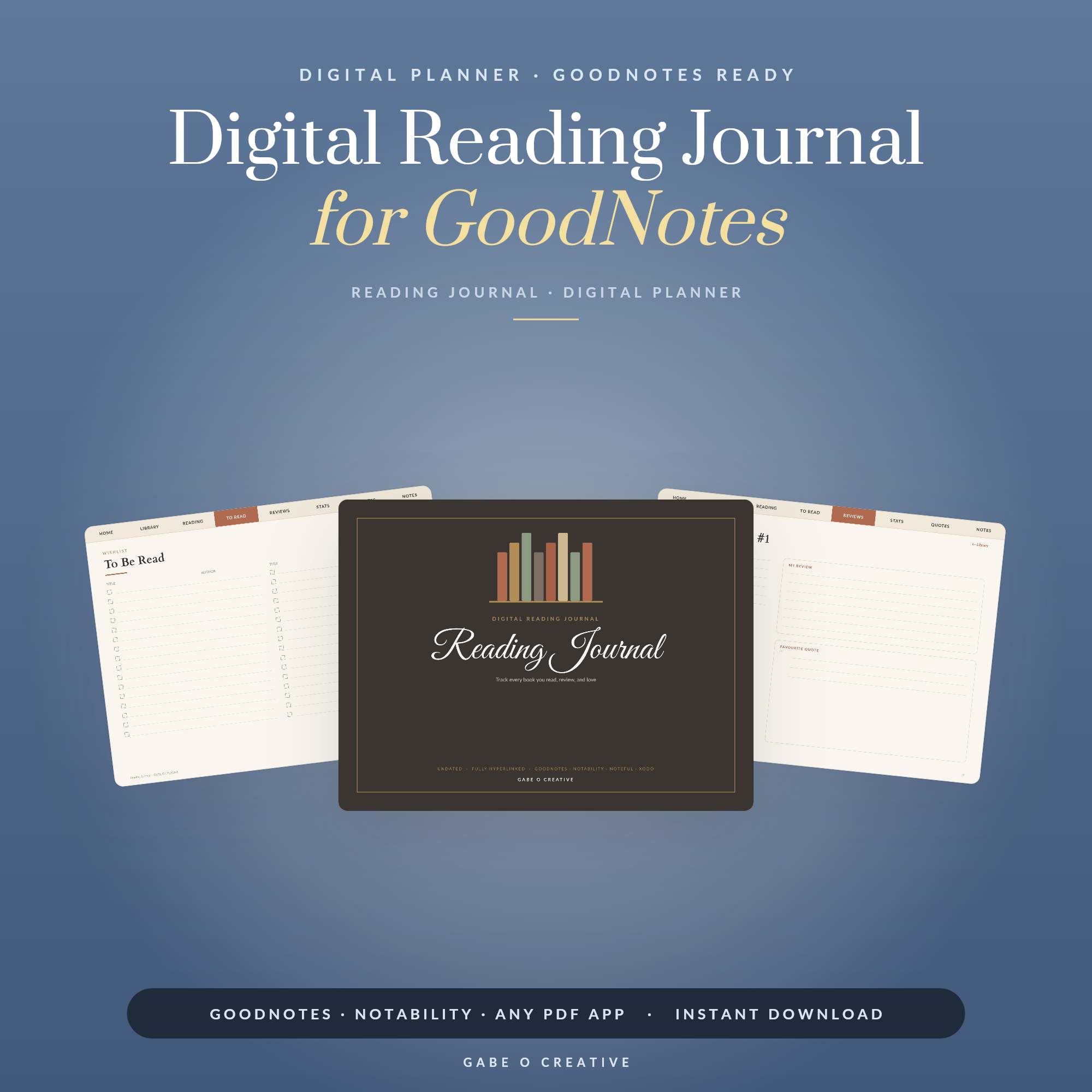 Shop Digital Reading Journal for GoodNotes →
Printable vs Digital Reading Log
There's no single 'best' reading tracker, only the one you'll actually open every week. Here's how the two options compare so you can pick your match.
A printable reading log is perfect if you love pen and paper, want something to stick on the wall, or like a screen-free moment before bed. Print as many pages as you need and never worry about batteries. A digital reading journal like our reading journal for GoodNotes is ideal for tablet readers: it lives on your iPad next to your ebooks, fills in with a stylus, and is always to hand, yet the same file prints beautifully if you change your mind. Either way, you get one tidy place to log every book, rate it and watch your list grow.
Want the whole lot in one go? The Ultimate Planner Mega Bundle includes the reading journal alongside dozens of other planners and trackers at the best value—handy if reading is just one of several habits you're building this year.
For more ways to make your tablet earn its keep, see our guide to using a digital planner in GoodNotes, browse the best productivity planner printables for staying on top of every goal, and if reading is part of your wind-down routine, the self-care journal printables guide pairs perfectly with a cosy reading habit.
Reading Log Printable FAQs
What is a reading log printable?
It's a print-at-home (or digital) page where you record each book you read along with the title, author, rating, dates and format. It gives you one tidy place to see everything you've finished and what's next on your list.
Does tracking my reading really help me read more?
Yes. Logging each book makes your progress visible and a little addictive, which nudges you to pick up a book instead of your phone. Seeing the list grow is surprisingly motivating, and it stops half-finished books from being forgotten.
What should I record in a reading log?
The essentials are the title, author, the dates you started and finished, the format (paperback, ebook or audiobook) and a star rating. Many readers also jot a one-line review, favourite quote or genre so the log doubles as a memory keeper.
What is a good reading challenge for beginners?
A book a month is a gentle, achievable start—twelve books a year feels brilliant. From there you can try a book a week, a genre challenge that pushes you out of your comfort zone, or simply working through your TBR (to-be-read) pile.
Can I use a reading log on my iPad or tablet?
Yes. Load the PDF into an app like GoodNotes or Notability and fill it in with a stylus, so you can log books anywhere without printing. The same file prints beautifully at home if you prefer pen and paper.
Printable, digital or an app, which reading tracker is best?
Printables suit pen-and-paper lovers, a digital journal is perfect for tablet users who want it always to hand, and a reading app auto-counts your books and totals pages for the data-minded. Pick whichever you'll actually open every week.
Ready to read more this year? Grab the reading journal and log your first book today, or explore the full Hobbies, Pets & Travel collection for everything you need to make this your best reading year yet. Every page gets you closer.