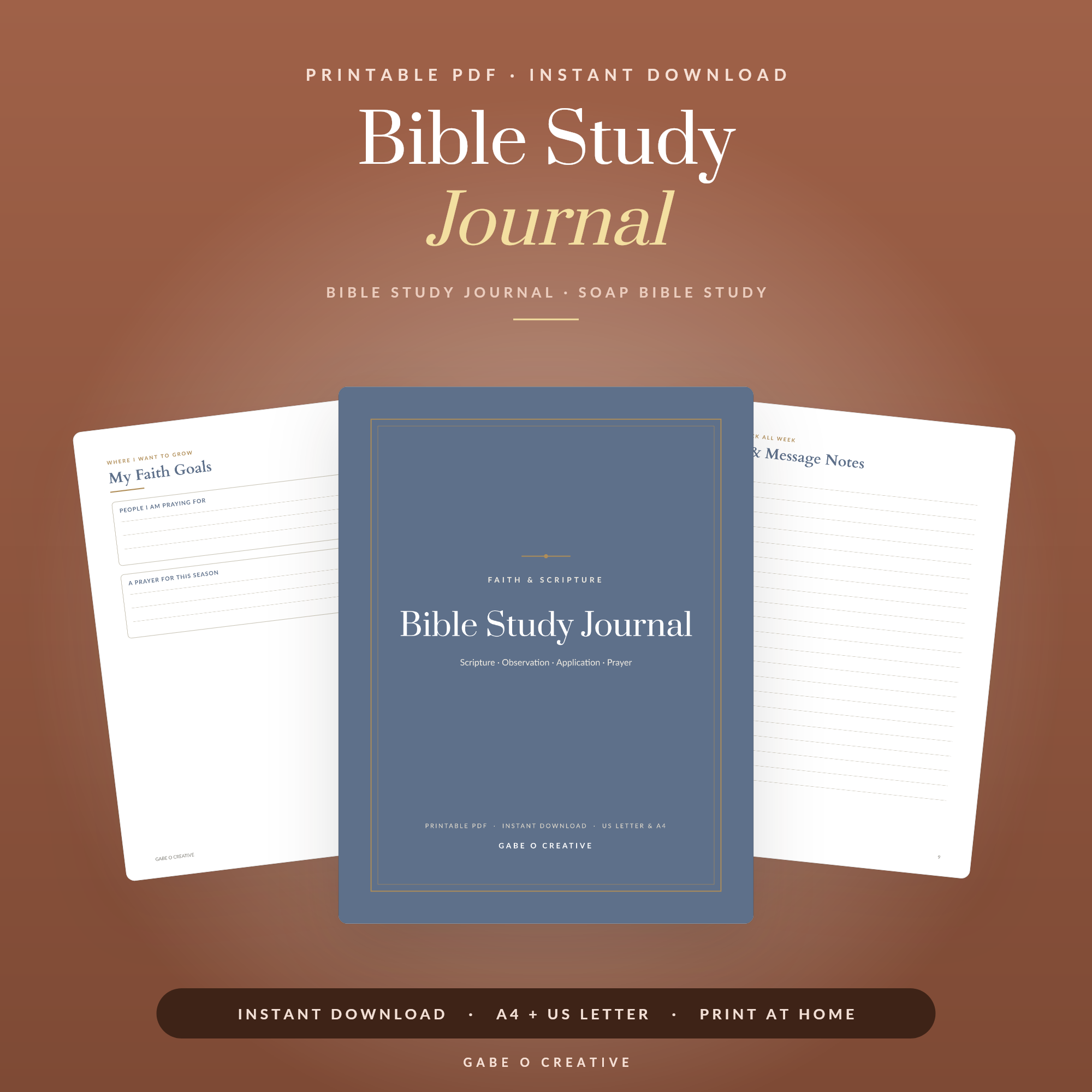
A bible study journal turns reading into something you keep. Most people who try one have the same experience: a strong first two weeks, then a run of blank pages and a quiet sense of failure. That is almost never a discipline problem — it is a structure problem. A blank page asks you to invent a format every single morning, and on a busy Tuesday you will lose that negotiation. The Bible Study Journal exists to remove that decision entirely.
If you have started a journal three times and stopped three times, the fix is not more willpower — it is fewer decisions.
What a Bible Study Journal Actually Is
It helps to separate three things that often get muddled. A prayer journal records what you are praying for and how those prayers are answered. A devotional is usually someone else’s short reflection that you read. A bible study journal is your own working notes on a passage — what it says, what you noticed, and what you intend to do with it.
The distinction matters because it sets the bar. You are not writing an essay or producing theology. You are taking useful notes on something you read, in the same spirit as notes from a lecture you genuinely wanted to attend. That framing makes the whole thing far less intimidating, and much more likely to survive a hard week.
 Shop Scripture Writing Plan →
The SOAP Method: A Simple Place to Start
SOAP is the most widely used structure for a reason: it replaces a blank page with four short prompts, and it works whether you have ten minutes or forty.
S — Scripture
Write out one verse, or a short passage, by hand. Not the whole chapter. Copying it out slows your reading down enough to actually notice the words, which is most of the value of journalling in the first place.
O — Observation
Write what you notice, plainly. Who is speaking, and to whom? What is repeated? What surprised you or sat awkwardly? There is no wrong answer here — you are describing, not interpreting.
A — Application
This is the line that makes the journal worth keeping. What does this change about this week? Keep it concrete and small: a conversation to have, a habit to drop, a person to call. "Be more patient" is a wish; "be patient with my daughter at bedtime" is an application.
P — Prayer
Two or three sentences responding to what you just read. Short is fine. This closes the loop and makes the entry feel finished rather than abandoned.
What to Write on Each Page
If you would rather see it laid out, here is what a complete entry contains and roughly how much time each part deserves.
| Section | What goes in it | Time |
|---|---|---|
| Date & passage | Reference only, e.g. John 15:1–11 | 10 seconds |
| Scripture | One verse copied out by hand | 2 minutes |
| Observation | 2–3 things you noticed | 3 minutes |
| Application | One specific action for this week | 3 minutes |
| Prayer | 2–3 sentences in response | 2 minutes |
| Verse to remember | Optional — one line to carry with you | 1 minute |
Around twelve minutes, start to finish. Knowing that in advance is what makes it possible to open the journal on a morning when you are already behind.
Building a Habit That Survives Busy Weeks
Three things separate people who keep a journal for a year from people who keep one for a fortnight.
Attach it to something you already do. Habits stick when they inherit an existing trigger — the first cup of tea, the commute, the ten minutes after the school run. A time of day is a weak anchor; an existing action is a strong one.
Lower the bar on hard days. Decide now what the minimum version looks like: one verse and one sentence. On a chaotic day you do the minimum rather than nothing, and the chain stays intact. Missing entirely is what breaks momentum, not writing briefly.
Leave gaps without guilt. If you miss four days, start again today and leave the pages blank. An undated journal helps enormously here because nothing looks wasted — there is no printed date silently reminding you of what you skipped. Our guide to prayer journalling covers the same principle from the prayer side.
Where you keep it matters more than you think
A journal in a drawer is a journal you will forget. Leave it physically where the habit happens — next to the kettle, on the bedside table, in the bag you take to work. Visual availability does more for consistency than any amount of intention, and it costs nothing to arrange.
It is also worth deciding in advance what you will do with a passage you simply do not understand, because that moment stops a lot of beginners. The answer is to write the question down and move on. You are not required to resolve every difficulty on the morning you meet it, and a journal full of honest questions is far more useful six months later than one full of tidy conclusions you did not really reach.
 Shop Bible Reading Tracker — Every book, every chapter — one beautiful record →
Pairing Your Journal With a Reading Plan
A journal answers "what do I write?" but not "what do I read?" — and that second question stalls just as many people. Pairing the two removes the last bit of friction.
A Bible Reading Tracker gives you the map, so you open the journal already knowing today’s passage. If you find that copying verses is the part that helps most, a Scripture Writing Plan gives you a themed verse for each day. For seasons when you want something gentler — illness, grief, a heavy work stretch — a daily devotional journal or a prayer journal keeps the habit alive with less effort. You can browse the whole Faith & Christian collection to see what fits the season you are in.
Start with one, not all four. The most common mistake is buying a complete system and using none of it; pick the single thing that solves your actual blocker and add later if you need to.
 Shop Prayer Journal →
Bible Study Journal FAQs
What is a bible study journal?
It is a notebook or printable set where you record what you read, what it meant, and what you plan to do about it. Unlike a diary, it follows a repeatable structure so each entry is quick to write and genuinely useful to look back on months later.
What is the SOAP method?
SOAP stands for Scripture, Observation, Application, Prayer. You write out a verse, note what you observe in it, work out how it applies to your week, then close in prayer. It gives you four short prompts instead of a blank page, which is why beginners stick with it.
How long should a bible study journal entry take?
Ten to fifteen minutes is plenty. The aim is consistency, not length. A short entry you write five days a week is far more valuable than a page-long reflection you manage twice a month and then abandon.
Where should a beginner start reading?
Most people find a gospel such as John or Mark the easiest entry point, or Psalms and Proverbs if you prefer shorter passages. Starting at Genesis and reading straight through is the most common reason beginners stall by Leviticus.
Do I need a special journal or will any notebook do?
Any notebook works. A structured journal simply removes the daily decision about what to write, which is the friction that stops most people. Prompts and prepared pages mean you open it and start rather than staring at blank paper.
What if I miss a few days?
Just start again on the next date and leave the gap. Trying to "catch up" on missed days turns a quiet habit into a backlog, and backlogs are what people quit. An undated journal makes this easier because nothing looks wasted.
Want the structure ready to go? Get the Bible Study Journal — undated SOAP pages, reflection prompts and reading space, printable at home and yours to reuse for good.