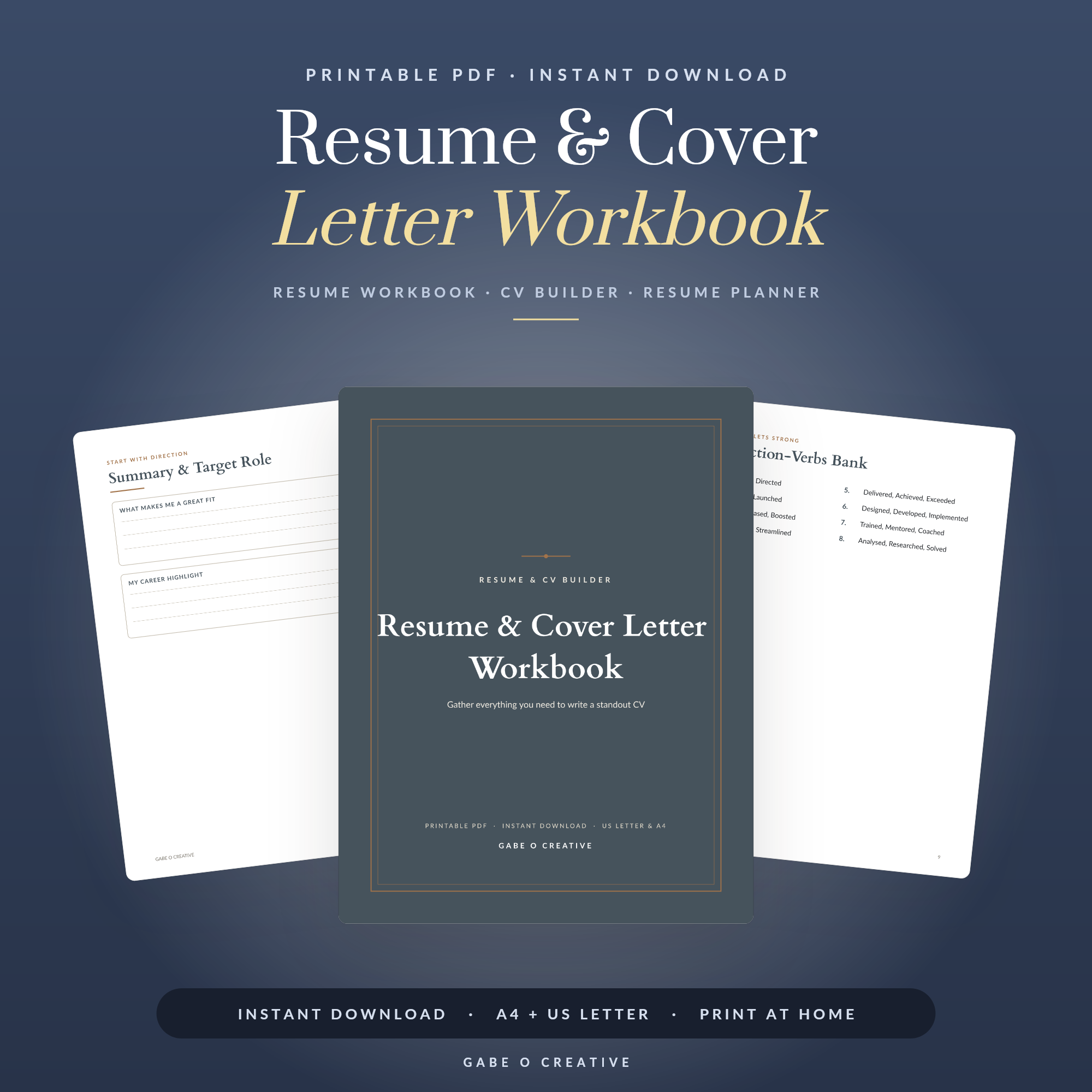
Two documents stand between you and an interview, and most people get both slightly wrong in the same predictable ways. The resume is padded with things nobody reads; the cover letter politely repeats the resume. Fixing a resume and cover letter is less about clever wording and more about ruthless editing — cutting what does not earn its place and sharpening what does. A structured Resume and Cover Letter Workbook walks you through both, but the principles below are the core of it.
A recruiter spends seconds on the first pass. Everything you keep on the page is competing for those seconds — so most of what people include is actively working against them.
What to Cut From Your Resume
Start by deleting, not adding. Most resumes improve the moment the dead weight comes off, because what remains gets more attention.
Cut the objective statement (“seeking a challenging role where I can grow” says nothing and wastes the most valuable space on the page). Cut your full address — a town and a contact method is plenty. Cut “references available on request”; it is assumed. Cut unrelated jobs from fifteen years ago, and cut generic duties that everyone in your role performs. “Responsible for answering emails” tells a recruiter nothing they did not already assume.
What earns its place is anything with a result. “Cut invoice errors by 30%” or “grew the mailing list from 400 to 3,000” survives the cut. Duties describe what you were meant to do; results prove what you actually did, and results are what get you interviewed.
 Shop Job Application Tracker →
What Actually Gets You an Interview
Once the clutter is gone, the resume should lead with your strongest, most relevant material. Recruiters read top-down and rarely reach the bottom, so the top third of page one is prime real estate — do not waste it on education from twenty years ago.
| Section | Keep it to |
|---|---|
| Name & contact | Name, phone, email, town, LinkedIn — one line |
| Short summary | 2–3 lines: who you are and your headline achievement |
| Experience | Recent and relevant, results-led bullets, most space here |
| Skills | Real, specific skills — not “hard-working team player” |
| Education | Brief; more detail only if you are early-career |
Write experience bullets as action → result: what you did, then what happened because of it. Numbers help enormously because they are concrete and comparable — percentages, amounts, time saved, volume handled. Even rough figures beat vague claims.
If you are early in your career, or changing fields, and feel short on results, do not pad — reframe. Coursework, volunteering, a side project or a part-time job all produced outcomes worth stating: an event you organised, a target you hit, a process you improved. Recruiters are not counting years so much as looking for evidence you can do the thing. One honest, concrete example carries more weight than three lines of soft, unverifiable adjectives.
How to Tailor Without Starting Over
“Tailor every application” is good advice that sounds exhausting. It is not, if you do it right. You are not rewriting from scratch each time — you are re-ordering and re-emphasising.
Read the job advert and note the skills and phrases it repeats. Those are the things that role cares about. Make sure your resume shows them clearly and near the top, adjust your summary to echo the role, and reorder your bullets so the most relevant sit first. Ten minutes per application, not an hour. Keep a master resume with everything on it, then cut down and reorder a copy for each job — a job application tracker helps you remember which version went where, which matters once you are applying to several roles at once. Our guide on how to organise a job search covers keeping the whole process straight.
Writing a Cover Letter That Says Something
The single biggest cover letter mistake is summarising the resume. The recruiter already has it. A cover letter’s job is to add what the resume cannot: why this role, why this company, and one concrete proof you can do it.
Keep it to three short paragraphs. Open with why this specific role at this specific company genuinely interests you — one honest sentence, not flattery. In the middle, give one concrete example that maps directly to what they need: a problem you solved that resembles their problem. Close with a simple, confident line about wanting to discuss it. That is the whole letter. Anything longer is usually padding, and padding reads as having nothing to say.
If interviews are the next hurdle, an interview prep planner helps you rehearse the answers that actually come up, and a job search planner keeps applications, deadlines and follow-ups from slipping. The full Career & Work collection covers the stages after the application too.
 Shop Interview Prep Planner →
Formatting, and Getting Past the Software
Before a human ever reads your resume, software often reads it first. Many employers use an applicant tracking system (ATS) that scans and parses your document, and a resume it cannot read is quietly filtered out before anyone sees it. The fix is not gaming the system — it is not tripping it up.
Keep the formatting clean and conventional. Use a standard, readable font, real text rather than text baked into an image, and simple section headings the software recognises — “Experience,” “Skills,” “Education.” Avoid tables, text boxes and multi-column layouts for corporate applications, because some parsers scramble them, turning a tidy resume into nonsense the moment it is scanned. Save and send as a PDF unless the advert specifically asks for a Word document, and name the file sensibly — “Jane Smith Resume.pdf,” not “resume-final-v3.pdf.”
The same discipline helps the human on the other side. White space is not wasted space; it is what lets a skim-reader find the important lines. Consistent bullet styling, aligned dates and a predictable structure all signal someone organised, before a word is even read. It is the quiet professionalism that a heavily designed, graphic-heavy template often undermines rather than conveys.
None of this requires design skill — a clean, ATS-friendly template handles the formatting so you can spend your energy on the words, which are the part that actually wins the interview.
 Shop Job Search Planner →
Resume and Cover Letter FAQs
What should I cut from my resume?
Cut the objective statement, an address, references-on-request, unrelated jobs from long ago, and any duty that everyone in your role does. Keep only what shows results or is directly relevant to the job you are applying for now.
How long should a resume be?
One page for most people, two if you have ten-plus years of relevant experience. Recruiters skim, so a tight one-pager that leads with your strongest, most relevant achievements beats a padded three-pager every time.
Do cover letters still matter?
Yes, when they are specific. A generic template adds nothing, but a short letter that connects your experience to this particular role and employer still tips decisions, especially for smaller companies where a human reads every application.
How do I tailor my resume to each job?
Read the job advert, note the key skills and words it repeats, and make sure your resume clearly shows those near the top. You are not lying — you are surfacing the relevant parts of your real experience for this specific role.
Should I use a resume template?
A clean, simple template helps — it keeps formatting consistent and readable, and saves hours. Avoid heavily designed templates with columns and graphics for corporate roles, as some applicant tracking systems struggle to read them.
What is the biggest cover letter mistake?
Summarising your resume. The recruiter already has your resume. A cover letter should add something new — why this role, why this company, and one concrete example that proves you can do the job.
Want both documents sorted properly? Get the Resume and Cover Letter Workbook — prompts, structure and examples to cut the clutter and write both without the blank-page dread.