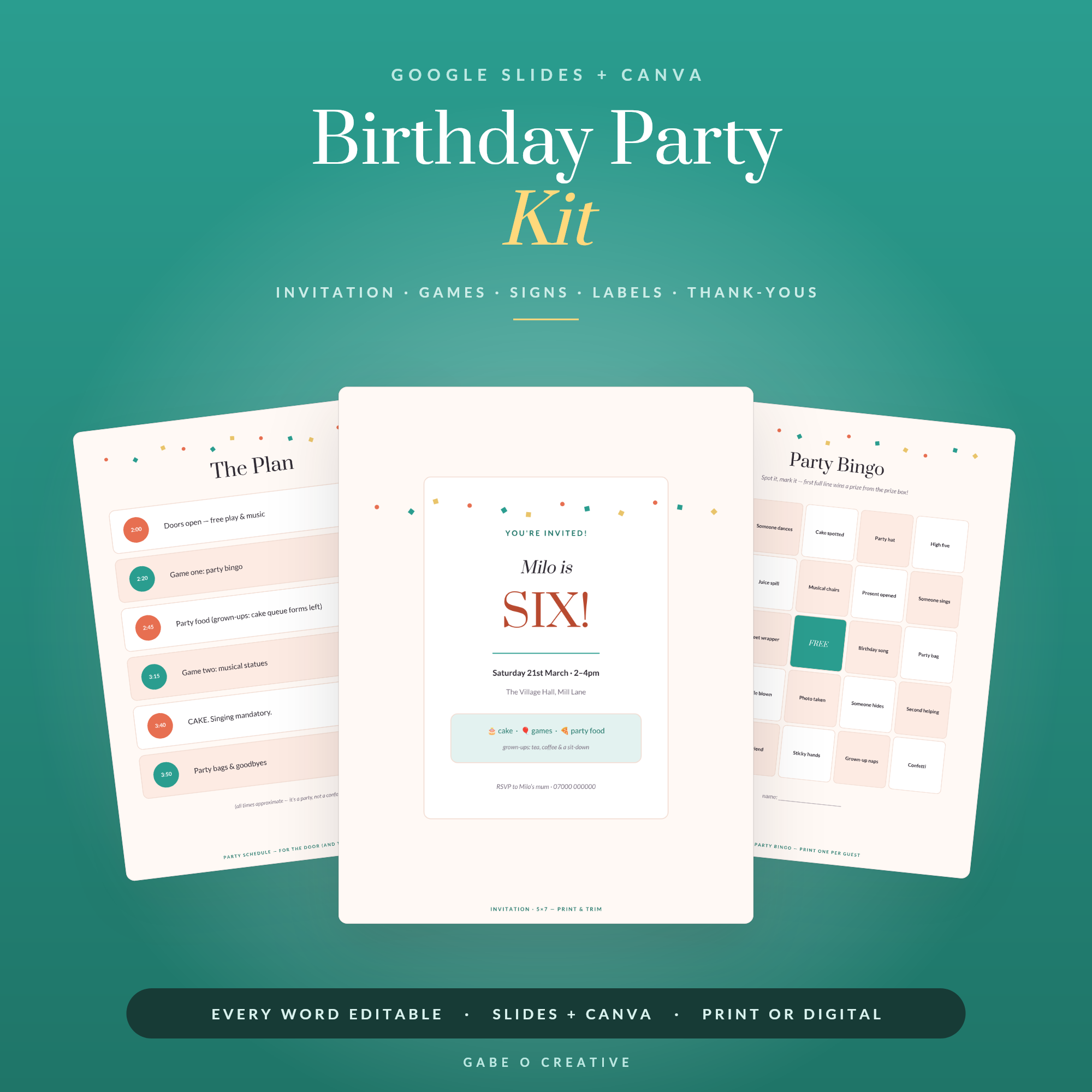
A birthday party only ever feels chaotic for one reason: everything gets left until the morning of. Spread the exact same jobs across two unhurried weeks and a birthday party checklist turns the whole thing into something genuinely enjoyable — for the person planning it, not just the person turning another year older. Below is that checklist, laid out day by day from two weeks out to the last candle, so nothing lands all at once. (Every printable piece you need — invitation, signs, games, food labels and thank-yous — is in the Birthday Party Kit.)
Want the party sorted tonight? The Birthday Party Kit gives you the invitation, welcome sign, party schedule, bingo, food labels and thank-you cards — all matching, all editable in free Google Slides or Canva. Type the name and the age, print, done.
Two weeks out: lock the things that can't move
The first week is entirely about decisions, not doing — and the golden rule is to settle everything that other people depend on before you touch a single balloon. That means, in this order: the date, the guest list, the venue (even if the venue is your living room), and anyone you're paying — an entertainer, a soft-play slot, a bouncy castle. None of it is real until it's confirmed, so chase the replies. Then send the invitations. Ten to fourteen days gives guests time to reply without giving them time to forget.
While you're there, ask the two questions that save the day itself: any allergies, and any guest who needs collecting rather than dropped. Both are far easier to handle now than at 3pm on party day with a plate in your hand.
 Shop Kids Birthday Party Planner →
One week out: the shopping and the shape
Now it becomes practical. With replies in, you know your numbers, so you can shop with a list instead of guessing. Buy the non-perishables — decorations, candles, party bags if you're doing them, the game bits — and order or book the cake. Fresh food waits until the day before; everything else is far calmer bought now.
This is also the week to decide the shape of the party, which is the single thing that separates a party that flows from one that sags. Two hours, roughly like this:
| Time | What's happening | Why it works |
|---|---|---|
| 0–20 min | Arrivals + free play | Guests trickle in; nobody's waiting on latecomers |
| 20–45 min | The big active game | Burns the early energy while everyone's fresh |
| 45–70 min | Food | Sit them down before they're overtired |
| 70–85 min | Cake + singing | The emotional peak — everyone together |
| 85–120 min | Calm game + collection | Winds down as parents arrive |
Write that running order down and stick it somewhere you'll see it. On the day your brain will be full; a schedule on the wall does the remembering for you, and any helper can glance at it and know what's next. The Birthday Party Kit has an editable schedule sheet for exactly this, plus a welcome sign for the door and bingo cards that keep every age busy in that tricky arrivals window.
Plan the games — then plan one more
Games are where parties live or die, and the mistake is always the same: too few, too fiddly, or explained to a room that's stopped listening. Plan three or four, keep the rules to one sentence each, and prepare one spare you can pull out if something flops. Aim for one active game early (musical statues, pass the parcel, a treasure hunt), one calmer one after food (bingo, a quiz, pin-the-tail), and one that runs quietly the whole time so there's never a dead moment.
The golden rule of party games is the same as the golden rule of baby shower games: would a shy guest dread this? If yes, cut it. Nobody came to be put on the spot. If you want the full thinking on games that guests genuinely enjoy versus the ones they merely endure, our guide to party games everyone actually plays applies just as well to birthdays.
 Shop Party Planning Checklist →
The day before: everything except the party
The day before is prep day, and the aim is to arrive at party morning with almost nothing left to do. Make the food that keeps, cut the sandwiches, fill the party bags, blow up the balloons, lay the table, charge the phone that's taking the photos, and put the cake somewhere safe from small fingers and large pets. Set out the games with their bits so you're not hunting for the blindfold mid-party.
Then — genuinely — stop. A calm host makes a calm party, and everything you do tonight is one less thing pulling you away from the birthday child tomorrow. If you keep a family hub on the fridge, the Family Command Centre is a good place to park the party jobs so the whole household can see what's left and pitch in.
Party day: host, don't cater
The single best decision you can make on the day is to do as little as possible during it. That's what the last two weeks were for. Food should be cold or already cooked, so you're not stuck in the kitchen while the party you planned happens without you. Rope in one other adult to run the door and the drinks so you can be present for the games and the cake — the two moments the birthday child will actually remember.
Keep the schedule loose. If a game is flying, let it run; if the room's flagging, bring the cake forward. The plan is there to lean on, not to obey. And when it's winding down, hand out the thank-yous — a printed card or a slice of cake in a napkin — and let people leave while it's still fun. A party that ends ten minutes early on a high beats one that limps to its official finish.
After the party: the ten-minute wind-down
Two small jobs close the loop and make next year easier. First, if any guest brought a gift, note who gave what before the wrapping paper goes in the recycling — a photo of each present with its tag is enough, and it turns thank-you notes from a chore into a two-minute job. Second, jot down what worked and what you'd change: too much food, one game too many, the wrong start time. Future-you, planning the next one, will be quietly grateful. Keeping a running family calendar — birthdays, who came, what was a hit — means you're never starting from a blank page again; our note on setting up a simple family system covers the fridge-door setup that makes all of this automatic.
Your questions, answered
How far in advance should you plan a birthday party?
Two weeks is plenty for a home party and stops the whole thing landing on one frantic morning. Send invitations 10–14 days out so guests can reply, and if you're booking a venue or entertainer, do that first — the date isn't real until they're confirmed. Bigger milestone parties are calmer with three to four weeks, but two weeks, spread sensibly, genuinely covers most.
What is the ideal length for a kids' birthday party?
Two hours is the sweet spot for most ages — long enough for arrivals, an activity, food and cake, short enough that nobody melts down. Under-fives do better at ninety minutes. The trick is a clear shape: arrive and play, one game, food, cake, calm activity while parents collect. A party that overruns its natural energy always ends in tears, usually the birthday child's.
How many games should you plan for a birthday party?
Plan three or four but be ready to drop one — you play to the energy in the room, not the schedule on the fridge. Have one active game to burn energy early, one calmer game for after food, and a bingo or hunt that runs quietly throughout. Always prepare one more than you think you'll need; a party with a spare game never stalls, and a stalled party is a long ten minutes.
What food should I serve at a birthday party?
Keep it simple, cold and picked-at: a spread of small things beats a hot meal nobody sits still for. Think sandwiches cut small, fruit, crisps, something beige the fussy ones will eat, and cake as the finale. Label anything with common allergens clearly and ask about allergies when guests reply. Food that needs plating or reheating steals the twenty minutes you most want to spend with the guests.
Do adults need a different birthday party plan?
The shape is identical — invitations, timings, food, a way to break the ice — just dressed differently. Swap party games for a quiz or a playlist, the goody bags for a nice candle or nothing at all, and squash into a longer window. The same checklist that runs a six-year-old's party runs a sixtieth; you change the age on the invitation and the volume of the music, not the plan.
What should go in a party goody bag?
Less than you think, and nothing that breaks before the child reaches the car. A single decent thing — a book, a craft, a proper toy — beats a bag of plastic that's landfill by Sunday. Or skip the bag entirely and send each guest home with a slice of cake and a genuine thank-you; plenty of parents quietly prefer that, and the birthday child never misses what was never promised.
Planning more than a birthday? If there's a baby on the way too, our baby shower games guide and the matching Baby Shower Suite take the same calm approach, and the printable Kids Birthday Party Planner is there if you'd rather plan on paper.
Two calm weeks, one lovely party. The Birthday Party Kit has the invitation, welcome sign, schedule, bingo, food labels and thank-yous — all matching and editable. Type the name, print the party.