A med surg brain sheet is the single page that holds a shift together — the thing you fold into a pocket at handover and unfold about four hundred times before you go home. Every nurse ends up with one, and almost every nurse ends up drawing their own because the ward's photocopied version has the wrong boxes in the wrong places. That is a solvable problem: an editable sheet lets you keep the layout and change the labels. The Nurse Brain Sheet Studio is built exactly that way.
Tired of redrawing the same sheet? The Nurse Brain Sheet Studio has med-surg layouts for one and two patients, plus ICU, A&E and paediatric versions — every box editable, so it matches your ward instead of somebody else's.
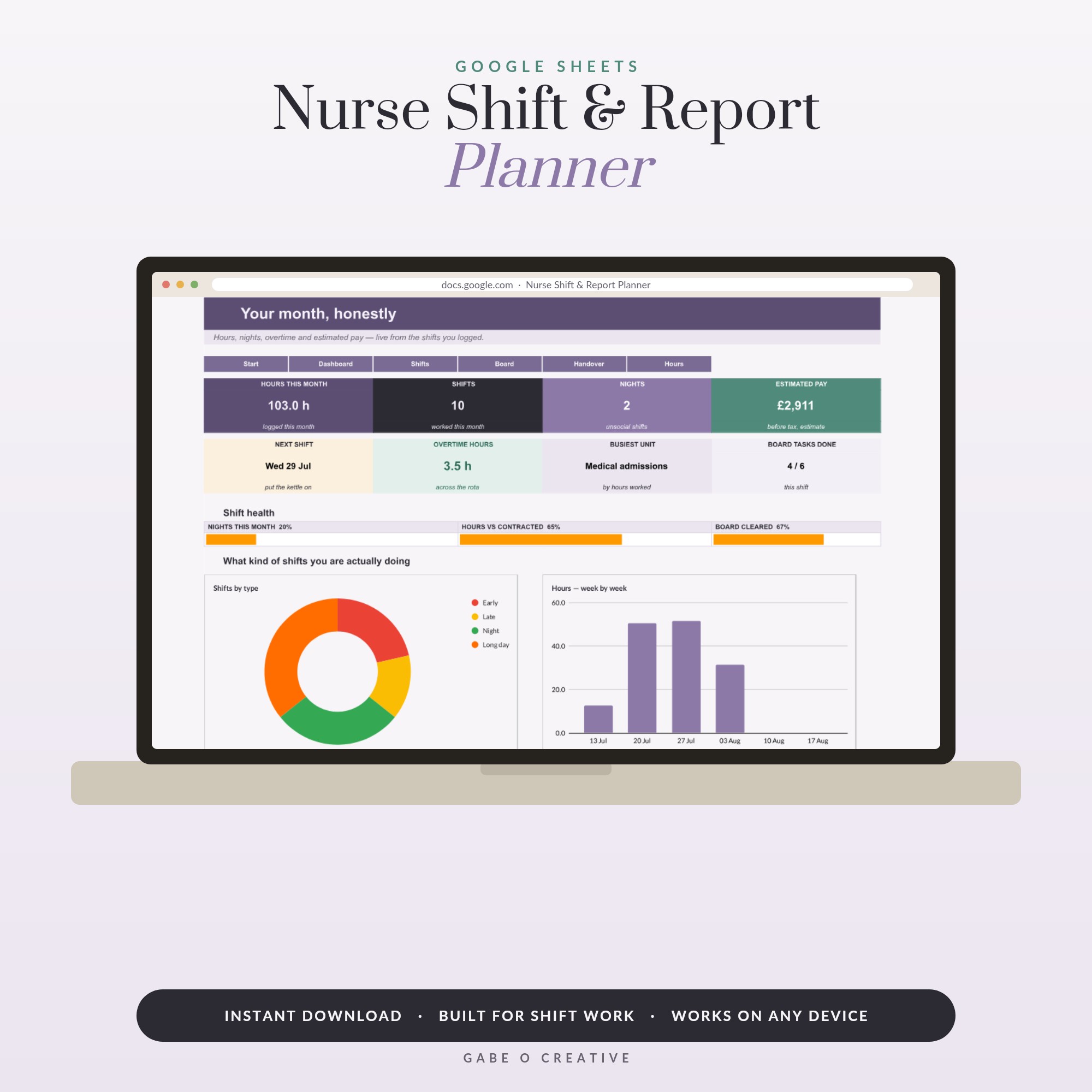 Shop Nurse Shift Planner Google Sheets, Rota & Hours Tracker with Pay Estimator, Patient Board Brain Sheet & SBAR Handover Template →
What a Brain Sheet Is For
It has one job: to keep in front of you the things you would otherwise have to remember or go and look up. That is all. It is not documentation, it is not a handover form, and it is emphatically not part of the clinical record — everything that matters clinically belongs in the notes and on the official charts.
Understanding that distinction is what keeps the sheet useful. Because it is only a memory aid, it can be messy, abbreviated and entirely personal. Because it is only a memory aid, it also must not carry identifiable information, and it has to be destroyed at the end of the shift.
Why the ward photocopy never quite fits
Most ward sheets have been photocopied from a photocopy since roughly 2014. The boxes reflect a bay that has since been reconfigured, and the layout assumes a handover style your unit no longer uses. Nurses respond by covering the margins in their own annotations — which is a strong signal about what the sheet should have contained in the first place. Watch what you write in the margins for a week; that is your real template.
What Actually Belongs on It
For a medical or surgical bay, this set covers almost everything without becoming a form:
- Bed and initials — never a full name.
- Age, because it changes your thinking about almost everything.
- Admitted for — one line, in your own words.
- Allergies — small box, top of the page, never buried.
- Lines and drains — what is in, and since when.
- Observations strip — a few timed columns, enough to see a direction of travel.
- Medications due — with times, because that is what drives your hour.
- Jobs this shift — the list you actually work from.
- Handover note — filled in as you go, not at the end.
The time column down the side
The one structural feature worth copying from good sheets is a narrow time ladder down the left edge, running from the start of your shift to the end. It turns a static form into a timeline: you can see at a glance that 14:00 is busy and 16:00 is empty, and move something before it becomes a problem. It is also the fastest way to spot that two patients need the same thing at the same moment.
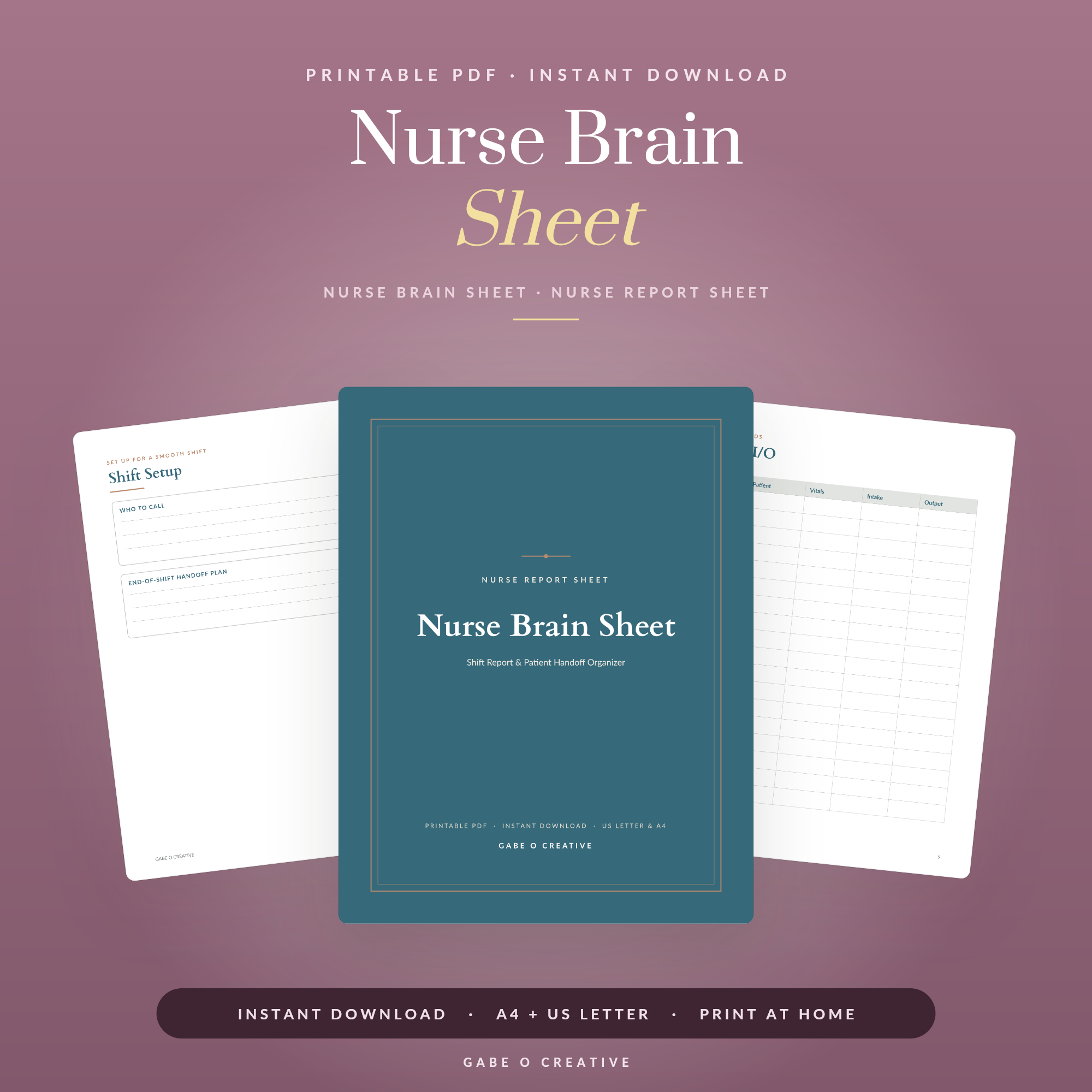 Shop Nurse Brain Sheet →
One Patient or Two to a Page?
It depends on the bay and on how much you write. The honest trade-off:
| Layout | Best for | Watch out for |
|---|---|---|
| One patient per page | Complex patients, students, unfamiliar wards | Shuffling four or five sheets in a pocket |
| Two per page | A settled bay of four to six | Boxes too small once things get busy |
| Whole-bay grid | Med times and jobs at a glance | No room for narrative or handover notes |
Plenty of people run two together: a whole-bay grid for medication times, plus one page per patient for the detail. That is not indecision, it is using each format for what it is good at.
Filling It In as You Go
The habit that changes a shift is writing the handover box during the shift rather than at the end of it. Two lines after each significant thing happens takes seconds; reconstructing eleven hours at 19:25 while someone waits takes twenty minutes and loses detail.
The same applies to the jobs column. Cross things off as you do them rather than keeping a mental tally, because the crossed-off list is what you will trust at 18:00 when you genuinely cannot remember whether you chased that scan. A sheet you keep current is a sheet that can answer questions; a sheet you update in bursts is just paper.
Keeping It Safe
Three rules, and they are not negotiable. Initials and bed numbers only — never full names, dates of birth, or NHS and patient numbers. Never take it off the unit, including in your uniform pocket. Dispose of it as confidential waste at the end of every shift.
It is worth reading your own employer's information-governance policy on this rather than assuming, because wards differ on what may be written on a personal sheet at all. If you are ever unsure, less on the page is always the safer answer — the sheet exists to prompt your memory, not to replace the notes.
If you want more background on the format itself and how nurses use it across specialties, our guide to the nurse brain sheet printable covers the wider picture. And the shift around the sheet matters too: the Nurse Shift & Report Planner handles the rota, hours, nights and estimated pay side, while the printable nurse report brain sheet is the fixed-layout version if you would rather not edit anything. Rotating shifts wreck routine more than any other part of the job, so if nights are eating your sleep and your meals, our guide to bookending your day with a morning and evening routine is written with irregular hours in mind, and the meal prep planner is the one that survives a run of long days when cooking properly is not happening.
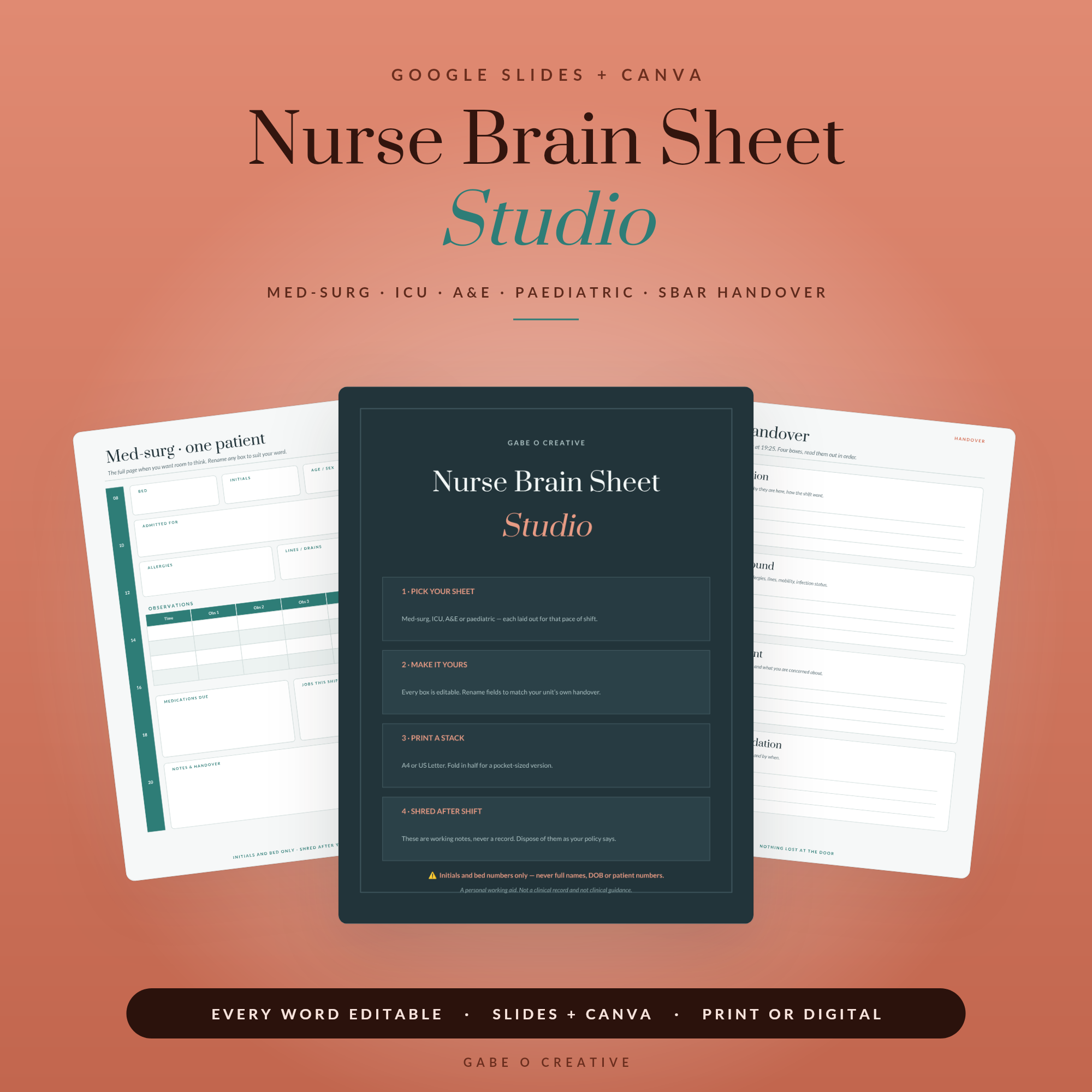 Shop Nurse Brain Sheet Editable Template for Google Slides & Canva, Med Surg ICU A&E Paediatric Report Sheets with SBAR Handover & Med Times Grid →
Med Surg Brain Sheet FAQs
What is a med surg brain sheet?
It is the working page a nurse carries through a shift on a medical or surgical ward — bed, initials, why the patient is in, what is due and what still needs doing. It is a personal memory aid, not part of the clinical record.
What should go on a med surg brain sheet?
Bed and initials, reason for admission, allergies, lines and drains, an observations strip, medications due with times, outstanding jobs, and a space for what you will hand over. Anything you find yourself flicking back to the notes for twice is a candidate to add.
How many patients should fit on one sheet?
One patient per page when you want room to think, or two per page on a busy bay. Beyond two the boxes get too small to write in quickly, and a sheet you cannot write on fast is a sheet you stop using.
Can I put patient names on my brain sheet?
No. Use bed numbers and initials only. Full names, dates of birth and patient numbers on a loose sheet are an information-governance risk, and your employer's policy will almost certainly prohibit it. Check that policy before you print anything.
What do I do with my brain sheet at the end of the shift?
Dispose of it as confidential waste — shredding or the designated bin on your unit. Never take it home, and never leave it in a pocket that goes into the wash with the uniform.
Is a printed brain sheet better than an app?
On a ward, usually yes. Paper works with gloves on, does not lock, does not need signal, and can be scribbled on mid-conversation. The trade-off is that paper must be disposed of properly, which an app does not require.
This is a guide to organising your own working notes. It is not clinical guidance, and nothing here replaces your unit's policies, your official charting or your professional judgement.
Make the sheet fit your ward. Open the Nurse Brain Sheet Studio, rename the boxes to match your handover, and print a stack for your next set — or browse the full Health & Fitness collection.