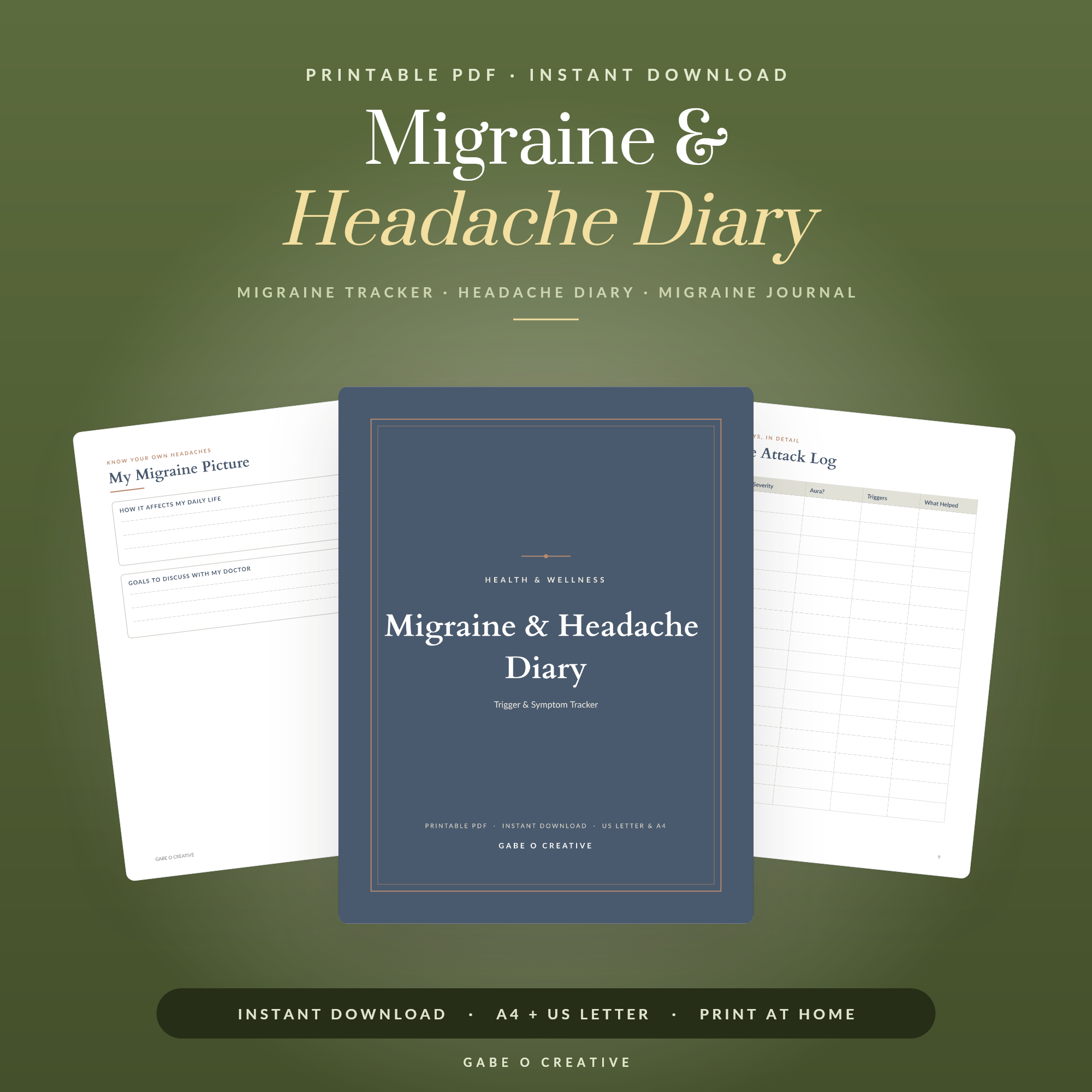
Almost everyone with migraine has a list of suspected migraine triggers, and most of those lists are wrong. Not through carelessness — because the attack usually begins hours or even days before the pain does, so whatever you were doing when it hit is rarely what caused it. Finding your real triggers is not a memory exercise; it is a record-keeping one, and it takes about three months. Our printable migraine and headache diary is laid out for exactly that.
Want to start today? Print the migraine diary and fill in today's row — even if you feel fine, especially if you feel fine.
 Shop Symptom Tracker →
Why Chocolate Keeps Getting Blamed
This is the clearest example of the whole problem. A migraine has a prodrome phase that starts hours before any pain — and one of its common symptoms is craving sweet food. So people crave chocolate, eat chocolate, get a migraine, and conclude that chocolate did it.
The chocolate was a symptom, not a cause. The attack had already begun.
The same logic applies to several other suspects. Neck stiffness before an attack is usually prodrome, not a cause. Yawning, thirst, irritability and food cravings are all early symptoms that get mistaken for triggers because they arrive first. Anything you notice in the hours before pain is at least as likely to be part of the migraine as the reason for it.
The 24-48 hour delay
The genuine trigger often lands a day or two before the attack. A late night on Friday can produce a Sunday migraine. If you only examine the day the pain started, you will blame the wrong thing consistently — which is exactly why the diary has to be filled in every day, not just on bad days.
What to Record
Keep it short enough to sustain. Six fields, daily:
| Field | Why it matters |
|---|---|
| Sleep hours and quality | Both too little and too much are common triggers |
| Meals and their timing | Skipped or late meals matter far more than what was eaten |
| Water | Dehydration is one of the most common and most fixable |
| Stress level, 1–5 | Note the let-down after stress too — see below |
| Cycle day, if applicable | Hormonal patterns need several months to appear |
| Anything unusual | Travel, weather change, alcohol, a new medication |
Then on attack days only, add four more: what time it started, any warning signs, what you took and when, and how long it lasted. That last one matters more than people expect — it is what shows whether treatment taken early works better than treatment taken late.
The let-down effect
Migraine frequently arrives after stress rather than during it — the Saturday of a hard week, the first day of a holiday. If you only record stress on the day of the attack, this pattern stays invisible, and you conclude your migraines are random when they are anything but.
 Shop Health & Fitness Planner Bundle →
How Long Before Patterns Show
Eight to twelve weeks, minimum. That feels long, and it is the single reason most tracking attempts fail — people stop at three weeks, see nothing, and conclude it does not work.
Migraine frequency varies enough month to month that a short window produces false patterns as readily as real ones. Hormonal triggers in particular cannot appear in fewer than three cycles. Two months of honest daily records tells you more than a year of remembering after the fact.
- Fill in the boring days. Days with no migraine are the comparison group — without them you have nothing to compare against.
- Do it at a fixed time, in the evening, so it becomes automatic.
- Do not analyse as you go. Looking for patterns weekly leads to seeing ones that are not there.
- Review monthly, and only look for things that appear repeatedly.
What to Do With It
After eight to twelve weeks, look for what shows up before attacks more often than it shows up otherwise. That comparison is the whole method — plenty of people find caffeine on their attack days and conclude it is a trigger, without noticing it is on almost every day.
Then change one thing at a time, for a month. Changing three at once teaches you nothing about which mattered. Start with whatever is easiest to control — meal timing and hydration are usually both the most common and the most fixable.
And take the diary to your GP or neurologist. A printed record of three months is dramatically more useful in a ten-minute appointment than trying to recall it, and it makes a real difference to whether preventive treatment gets considered. This is general information rather than medical advice — new, sudden or severe headaches always need a doctor rather than a diary.
If you are tracking a wider condition, the chronic symptom tracker covers the same discipline across more symptoms, and the menopause symptom tracker handles the hormonal side in more depth — worth knowing, since perimenopause is a common and often missed reason migraines change in your forties. Our migraine tracker guide covers choosing and using the sheets themselves.
 Shop Menopause and Perimenopause Symptom Tracker Guide, Hormone Health Journal Printable, Hot Flash and Mood Log, Self Care Workbook PDF →
The Triggers Worth Suspecting First
Not all triggers are equally likely, and starting with the common ones saves months. Roughly in order of how often they turn out to matter:
- Sleep, in either direction. A late night and a long lie-in are both common triggers, which is why weekend migraines are so frequent. Consistency matters more than duration.
- Skipped or late meals. Usually a bigger factor than anything you actually ate. The gap is the trigger, not the food.
- Dehydration. Unglamorous, extremely common, and the easiest single thing to fix.
- Hormonal shifts. For menstruating people this is often the strongest pattern of all, and it only becomes visible across several cycles.
- The let-down after stress. The Saturday migraine after a hard week.
- Weather and pressure changes. Real for many people and completely outside your control — worth identifying so you stop hunting for a cause you could have avoided.
Food triggers are far rarer than their reputation suggests. Red wine and aged cheese are genuine for some people, but most food suspicions turn out to be prodrome cravings once there is a proper record to check against.
When a trigger turns out to be uncontrollable
Some are. Weather, hormones and travel are not things you can simply remove. That is still worth knowing, because it changes the strategy — you stop trying to prevent those attacks and start planning for them: medication to hand, a lighter diary in the week before a period, an earlier night before a flight. Knowing an attack is likely is genuinely useful even when you cannot stop it.
Migraine Trigger FAQs
What are the most common migraine triggers?
Sleep changes, skipped meals, dehydration, hormonal shifts, stress — and notably the let-down after stress rather than the stress itself. Weather and bright light are common too. Food triggers are far rarer than most people assume.
Why does chocolate get blamed so often?
Because a craving for sweet things is a symptom of the prodrome phase, which begins hours before the pain. People eat chocolate because a migraine is already starting, then blame the chocolate. It is one of the most persistent mix-ups in migraine tracking.
How long do I need to track before patterns show?
At least eight to twelve weeks. Migraine frequency varies enough month to month that anything shorter tends to produce false patterns, and hormonal triggers need several cycles to become visible at all.
What should I record each day?
Track every day, not only attack days — sleep hours, meals and their timing, water, stress, and for menstruating people, cycle day. Then on attack days add the time it started, warning signs, and what you took.
Why does the delay between trigger and attack matter?
Attacks often begin 24 to 48 hours after the trigger. If you only look at the day the pain started, you will consistently blame the wrong thing — which is why tracking every day, not just bad days, is essential.
Is a paper diary better than an app?
Paper tends to be filled in more honestly and completely, and a printed sheet is far easier to hand to a GP or neurologist than a phone. Use whichever you will actually maintain for three months.
Start tonight, even if today was fine. Print the migraine and headache diary, or browse the full Health & Fitness collection for symptom trackers and health logs.