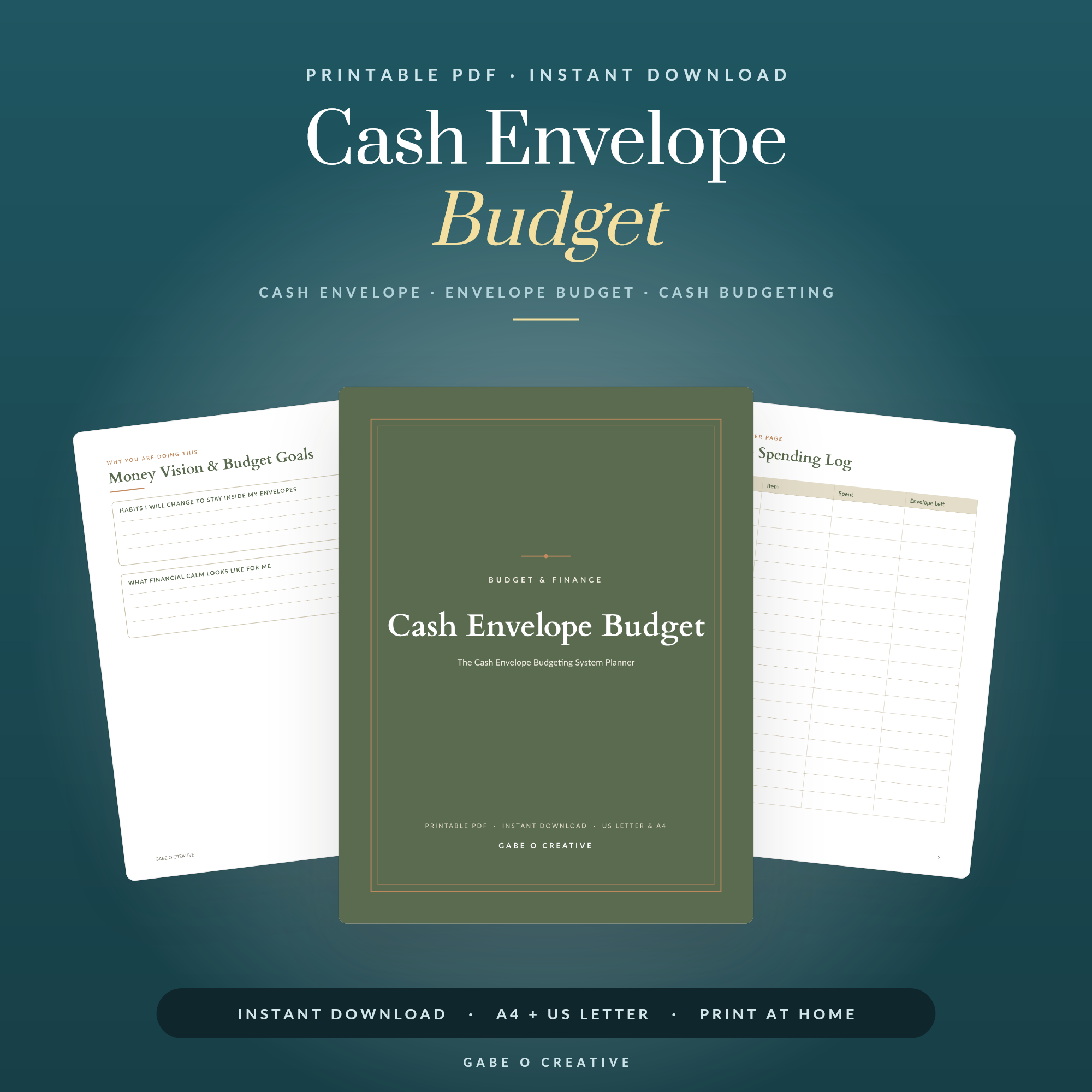
A cash envelope system printable is the simplest, most satisfying way to stop overspending and actually feel in control of your money. The idea is old-school but it works: you divide your spending money into labelled envelopes—groceries, eating out, fun, petrol—and when an envelope is empty, you're done spending in that category until next payday. Print the templates, stuff them with cash, and your budget suddenly becomes something you can see and hold.
Want to start tonight? Our ready-to-print cash envelope kit includes the envelope templates and category trackers you need—print, fold, fill, done.
 Shop Monthly Budget Planner →
What Is the Cash Envelope System (and Why It Works)
The cash envelope system—sometimes called cash stuffing—is a budgeting method where you withdraw your spending money and split it into category envelopes. Each envelope holds the amount you've budgeted for that category that month. Once it's gone, it's gone. There's no overdraft, no 'I'll deal with it later', just a clear, physical limit.
A good cash envelope system printable gives you the templates to make this effortless:
- Pre-labelled envelopes so setup takes minutes, not an afternoon.
- Category trackers to log what you spend and what's left.
- Sinking fund pages for saving toward bigger, irregular costs like Christmas or car repairs.
Why cash envelopes curb overspending
There's real psychology here: studies on the 'pain of paying' show that handing over physical cash hurts more than tapping a card, so you spend more deliberately. When you can literally see your grocery envelope getting thin, you make different choices at the till. That visible, tangible limit is something a banking app simply can't replicate.
The system suits anyone who keeps thinking 'I have no idea where my money goes.' It's especially powerful if you tend to overspend on a card, share a budget with a partner, or are rebuilding after a tough financial patch. Because the limit is physical, there's no clever maths to do in the moment—when the envelope is empty, the decision is already made for you.
How to Set Up Your Cash Envelope System Printable
Setting up takes about fifteen minutes. Follow these steps:
- Print your envelopes and trackers. Use A4 or US Letter paper—the kit works with both.
- Choose your categories. Pick the few areas where money tends to slip away.
- Set each amount. Look at last month's spending and set a realistic, slightly tighter limit.
- Withdraw and stuff. Take out the cash and divide it into the envelopes on payday.
- Spend only from the envelope. When it's empty, pause until next month.
Step 1: pick your categories
Focus on variable, tempting categories—not fixed bills. Rent, insurance and subscriptions are best left on direct debit. Envelopes shine for the day-to-day spending that's easy to lose track of.
Step 2: decide your amounts
If you don't know your numbers yet, log a normal month first with a simple daily expense tracker, then set each envelope just below your usual spend. That small squeeze is where the savings come from.
Step 3: stuff, spend, and adjust
On payday, withdraw your spending cash and divide it into the envelopes. Throughout the month, spend only from the matching envelope and jot the remaining balance on the tracker. At month-end, review: if groceries always run out a week early, nudge that amount up and trim somewhere else. The first month or two is about calibration—your envelopes get more accurate every cycle.
Best Cash Envelope Categories to Start With
You don't need twenty envelopes. These are the categories our customers find make the biggest difference:
- Groceries—the classic overspend, and the easiest win.
- Eating out & takeaways—small amounts that quietly add up.
- Fun money—a guilt-free amount so the budget doesn't feel like a punishment.
- Petrol or transport—keeps a lid on a sneaky weekly cost.
- Personal care—haircuts, cosmetics and the odd treat.
 Shop Budget & Finance Planner →
Common Cash Envelope Mistakes to Avoid
A few easy slip-ups can derail the system in the first month. Watch out for these:
- Too many envelopes. Five well-chosen categories beat fifteen you can't keep up with.
- Setting unrealistic limits. If groceries genuinely cost more, budget honestly—then trim somewhere else.
- Raiding other envelopes. Borrowing from 'fun' to top up 'groceries' quietly defeats the purpose.
- Forgetting sinking funds. Set a little aside each month for big irregular costs like Christmas or car repairs so they never blow the budget.
None of these are dealbreakers—just budget honestly, keep it simple, and let the system tighten naturally over a couple of months.
Cash Envelopes vs Digital Budgeting
Cash isn't the only way to run this system. Here's how the two approaches compare:
| Cash envelopes | Digital version |
|---|---|
| Most powerful for curbing impulse spending | More convenient for online shopping and bills |
| Physical limit you can see and feel | Tracked in a printable or planner instead |
| Best for problem categories | Best for fixed, predictable costs |
Many people do both: cash for the tempting categories, and a month-at-a-glance budget planner for everything else. That hybrid gives you the discipline of cash where it matters and the convenience of digital where it doesn't.
Make It Stick: Pair Your Envelopes With a Budget
Envelopes control your spending, but a full budget tells you how much should go into each one. For the complete picture, slot your envelope categories into the all-in-one Budget & Finance Planner binder, or grab the complete budget and finance bundle to get the envelopes, trackers and monthly budgets together at the best price.
New to budgeting overall? Start with our roundup of the best budget planner printables to see how all the pieces fit. And if debt is on your radar, the cash envelope method pairs perfectly with a debt snowball tracker so every spare pound goes straight to your balances.
 Shop Expense Tracker →
Cash Envelope System Printable FAQs
What is a cash envelope system printable?
It's a set of print-at-home templates—labelled envelopes and category trackers—that let you divide your spending money into categories. When an envelope is empty, you stop spending in that category until next payday.
How many cash envelopes should I start with?
Start with three to five problem categories like groceries, eating out, petrol and fun money. Too many envelopes gets unwieldy, so add more only once the first few feel natural.
Can I use the cash envelope method without carrying cash?
Yes. Many people run a digital version, tracking each category in a printable or planner and moving money between sub-accounts instead of physical notes.
Does the cash envelope system actually work?
It works because spending physical cash feels more real than tapping a card, so you naturally slow down. The visible limit in each envelope is what curbs overspending.
What categories work best for cash envelopes?
Variable, easy-to-overspend categories work best—groceries, takeaways, entertainment, clothing and petrol. Fixed bills like rent are better paid by direct debit.
How much cash should I put in each envelope?
Base each envelope on your real spending from the last month or two, then set it slightly lower to build in savings. Expect to fine-tune the amounts after your first cycle once you see what's genuinely realistic for your household.
Ready to take back control? Print the cash envelope kit and set up your first envelopes tonight, or browse the full Budget & Finance collection to build a system that fits your life. Your future balance will thank you.