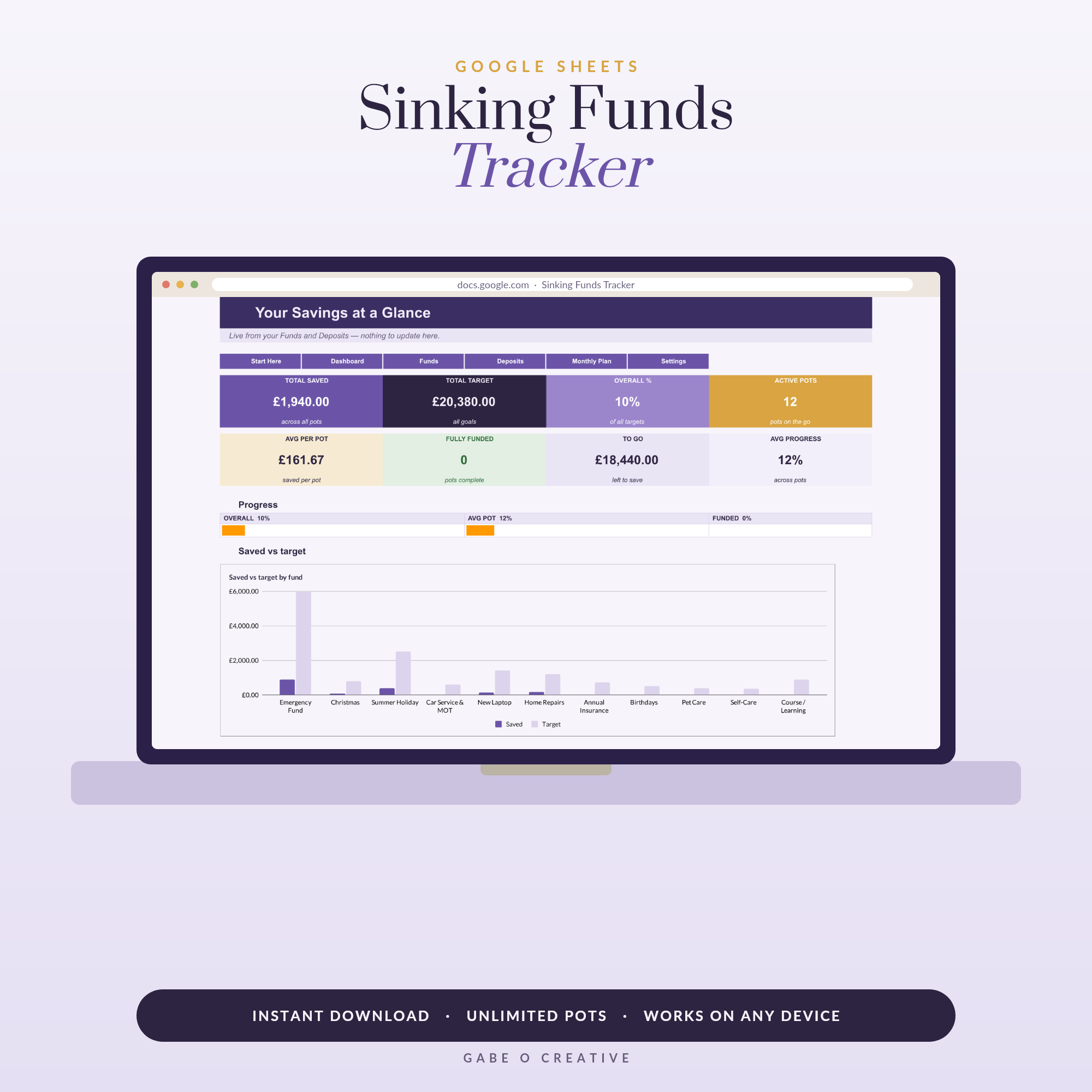
Sinking funds are the quiet budgeting trick that stops money stress before it starts. Instead of being ambushed by Christmas, the car service or the annual insurance renewal, you set aside a small amount each month so the cash is already waiting when the bill lands. It's the difference between dreading certain months and barely noticing them. If you're tired of irregular costs blowing your budget apart, a simple sinking funds tracker is the easiest way to take control.
Want to set up your first pots today? Our Sinking Funds Tracker lets you name every fund, set a target and watch each pot fill up—print it and start in minutes.
 Shop Sinking Funds Tracker →
What Is a Sinking Fund?
A sinking fund is money you save gradually for a specific, known expense that doesn't fall every month. Think Christmas, a summer holiday, your car's annual service, or that insurance renewal that always seems to arrive at the worst possible time. Rather than scrambling for the full amount when the bill is due, you break it into bite-sized monthly chunks. By the time the cost arrives, the money is already sitting there—calm, expected and fully funded.
The beauty of a sinking fund is how undramatic it is. You're not hoping to win the lottery or slashing your lifestyle. You're simply moving a known cost out of one scary month and spreading it gently across the year. A good sinking fund helps you:
- Turn big bills into small ones you barely feel.
- Stop reaching for credit cards when an expected cost lands.
- Plan ahead for the things you already know are coming.
- Sleep better knowing the money is ready before the bill is.
Sinking fund vs emergency fund
People often muddle these two, but they do very different jobs. A sinking fund is for expenses you know are coming but not every month—a holiday, a birthday, the MOT. You can see them on the calendar. An emergency fund is for the genuinely unexpected: a sudden job loss, a broken boiler, an urgent vet bill you never saw coming. You plan and spend a sinking fund on purpose; you hope to never touch your emergency fund at all. Most people who feel financially secure run both side by side—the sinking funds handle the predictable, and the emergency fund covers the shocks.
Why Sinking Funds Stop Surprise Bills Wrecking Your Budget
Here's the trap a normal monthly budget falls into. You carefully balance your income against rent, food, fuel and the usual bills, and it all works—until December arrives, or the car needs £400 of tyres, or the home insurance renews for £350 in one go. Suddenly a budget that was perfectly fine gets blown to pieces, and the gap usually gets filled with a credit card or an anxious overdraft.
The thing is, none of those costs were actually surprises. You knew Christmas was coming and that the car would need work eventually. They only felt like surprises because nothing was set aside for them. Sinking funds fix this by making the irregular regular: every lumpy annual cost becomes a small, steady line in your monthly budget, so no single month ever absorbs the full blow. That's the secret behind people who always seem to have money ready—they've just smoothed the bumps out in advance.
 Shop Savings Challenge Tracker →
Common Sinking Fund Categories
The best sinking fund categories are simply the big, irregular costs that catch you out. Everyone's list is a little different, but these are the ones that show up again and again:
- Christmas — gifts, food, travel and the little extras that add up fast.
- Car — servicing, MOT, tyres, repairs and road tax.
- Holidays — flights, accommodation and spending money.
- Insurance and renewals — home, car, pet and any annual subscriptions you pay in a lump.
- Pets — vaccinations, vet visits, food and the occasional emergency.
- Home repairs — appliances, boiler servicing and general maintenance.
- Birthdays and celebrations — spread across the year so no single month stings.
- Back-to-school — uniforms, shoes and supplies if you have children.
You don't need all of these. Start with the three or four costs that wrecked your budget last year—if Christmas and the car always hurt, begin there. You can add more pots as you go. Once your most painful expenses are covered, the rest of your budget suddenly has a lot more breathing room.
How to Work Out Your Monthly Amount
This is the part that makes sinking funds feel almost magical, and the maths could not be simpler. Take the total cost of the thing, then divide it by the number of months until you need the money:
Total cost ÷ months to save = your monthly amount.
So a £600 Christmas spread across 12 months is just £50 a month. A £240 car service due in eight months is £30 a month. Each cost shrinks into something easy to find, and together they form a single, predictable savings figure you add to your budget. Here's how a handful of common pots might look:
| Goal | Target | Months | Monthly amount |
|---|---|---|---|
| Christmas | £600 | 12 | £50 |
| Car service & MOT | £240 | 8 | £30 |
| Summer holiday | £900 | 10 | £90 |
| Home insurance renewal | £360 | 12 | £30 |
| Pet care | £180 | 6 | £30 |
Add those up and you'd be setting aside £230 a month—but look at what it buys you: a funded Christmas, a stress-free car service, a paid-for holiday, a covered renewal and a buffer for the pets. If a date is already close, just divide by the months you have left; the amounts flex to fit whatever you can manage.
Where to Hold the Money and How to Track It
Once you know your amounts, you need somewhere to keep the cash—and crucially, somewhere it won't get spent by accident. There are two simple approaches that work brilliantly:
One account, named pots
Open a single separate savings account and keep all your sinking funds in it, tracking each one as a named 'pot' on paper or in your tracker. Plenty of banks now offer built-in 'spaces' or 'pots' that let you label money inside one account, which makes this even easier. The key is keeping it apart from your everyday current account so the money is out of sight and out of temptation.
This is where a sinking fund tracker earns its place. A sinking fund tracker is simply the record of what each pot is for, what it needs to reach, when it's needed by, and what's in it today — one row per fund. It doesn't matter whether that lives on a printed sheet on the fridge or in a spreadsheet; what matters is that the shared account balance can always be broken back down into named pots. Without a tracker you have one number and no idea which of your funds it belongs to.
However you split it, the part people get wrong is the tracking. If all your funds share one account, you must record how much belongs to each pot, or you'll have no idea whether your Christmas money is really there or quietly spent on the car. That's exactly what a Sinking Funds Tracker is for—name each pot, set its target, and log every contribution so you always know precisely where you stand. If you'd rather make saving feel like a game while you fill those pots, the Savings Challenge Tracker is a fun way to build the saving habit in the first place.
 Shop Budget & Finance Planner →
Build a Sinking Fund System That Lasts
Sinking funds work best as part of a wider budget that has a little room to spare. Pair your tracker with the complete Budget & Finance Planner binder to map your income, bills and savings in one place, or grab the Budget & Finance Planner Bundle for the tracker, planner and more together at the best value.
It's also worth pairing sinking funds with smart spending habits. If overspending is what eats the money you'd otherwise save, our guide to the cash envelope system is a perfect companion, and the savings challenge is a brilliant way to kick-start each pot. For the bigger picture of organising your whole money life, see our roundup of the best budget planner printables.
Start small. Pick one expense that always catches you out, work out the monthly amount, and open your first pot this week. Once you feel how good it is to have December's money ready in July, you'll want a pot for everything.
Sinking Funds on an Irregular Income
Freelancers and shift workers often assume sinking funds are not for them — you cannot promise £50 a month when you do not know what you will earn. Flip the method and it works well: fund by percentage, not fixed amount. Decide that, say, 12% of every payment that lands goes to your pots, split by priority. A £2,400 month feeds the pots £288; a £900 month feeds them £108. The pots fill unevenly, but they fill — and because the targets have dates, you can see early when one is running behind while there is still time to nudge it.
Two extra rules help on a bumpy income. First, rank the pots: insurance and car costs, the ones with consequences, get filled before the holiday fund. Second, in a bumper month, top up the lagging pots to schedule before anything else. That single habit is why irregular earners running sinking funds often feel steadier than salaried friends — the lumpy income smooths itself inside the pots before it reaches daily life.
Sinking Funds FAQs
What is a sinking fund tracker?
A simple record of every pot: what it is for, the target amount, the date you need it by, and the balance today. It is what lets one savings account hold several sinking funds without you losing track of which money belongs to which goal.
What is a sinking fund?
A sinking fund is money you set aside little by little for a known, irregular expense—like Christmas, car servicing or an insurance renewal. Instead of one painful bill, you save a small amount each month so the cash is already there when it's due.
What is the difference between a sinking fund and an emergency fund?
A sinking fund is for expenses you know are coming but not every month, like a holiday or an MOT. An emergency fund is for the genuinely unexpected—a job loss or a boiler breakdown. You plan a sinking fund; you hope never to touch your emergency fund.
What are the most common sinking fund categories?
Popular ones include Christmas, car repairs and servicing, holidays, insurance and subscription renewals, pets, home maintenance, birthdays and back-to-school. The right list is simply whatever big, irregular costs catch you out each year.
How do I work out how much to put in a sinking fund?
Take the total cost of the thing, then divide it by how many months you have until you need the money. A £600 Christmas spread over 12 months is just £50 a month—far easier to find than £600 in December.
Where should I keep my sinking fund money?
Most people use one separate savings account and track named 'pots' within it, or use a bank that offers spaces or pots built in. Keeping it apart from your current account stops the money getting spent by accident.
Do I really need sinking funds if I already budget?
Yes—this is the piece most budgets miss. A standard monthly budget handles regular bills well but gets blown apart by the once-a-year costs. Sinking funds smooth those out so no single month ever takes the hit.
Ready to stop the surprise bills? Grab the Sinking Funds Tracker and set up your first pot today, or explore the full Budget & Finance collection for everything you need to take control. Future you will be so glad you started.