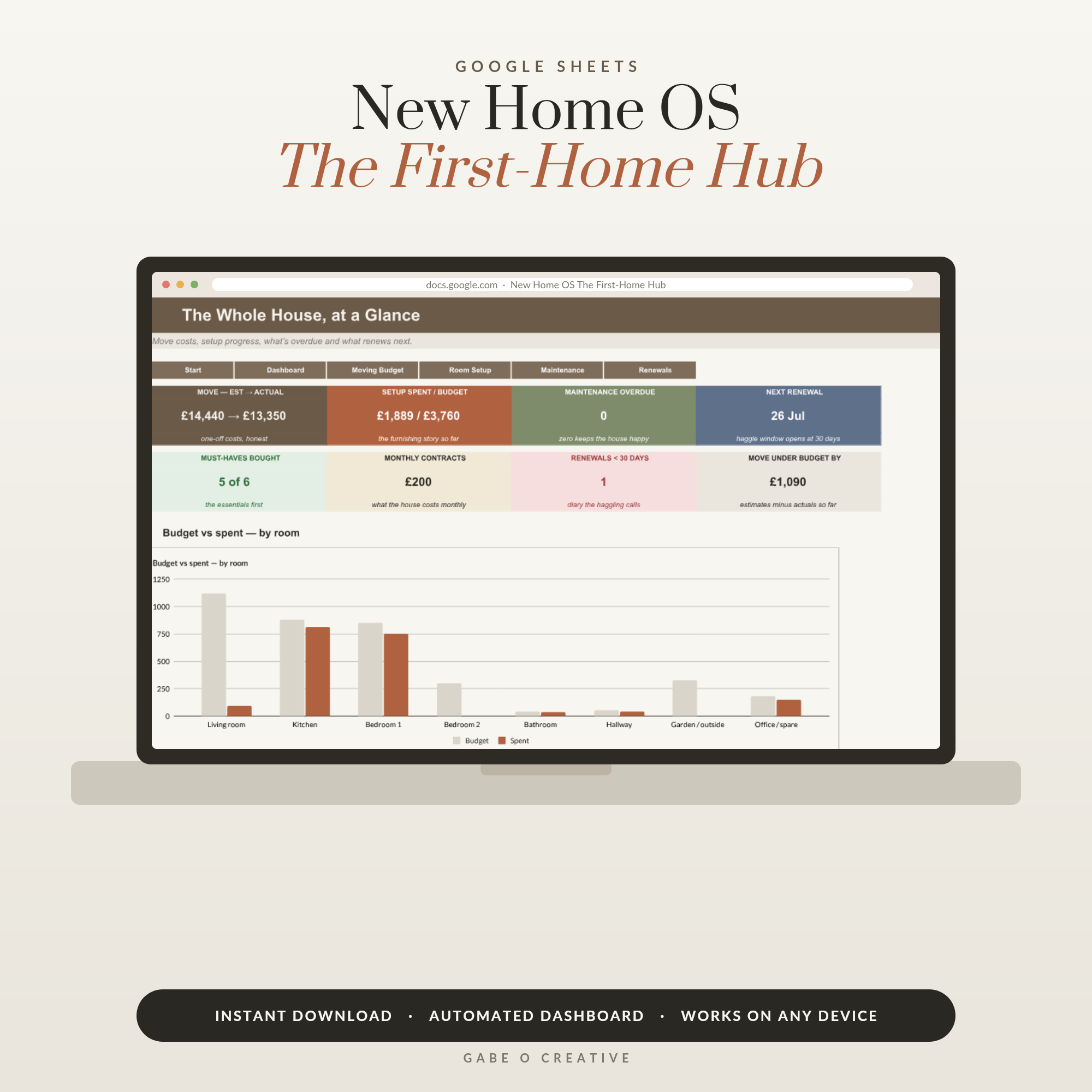
Nobody tells you that completing on a house comes with a second job. The mortgage was the visible mountain — but behind it hides a new homeowner checklist of meter readings, lock changes, council tax, boiler services, warranty registrations and renewal dates, and the expensive ones are the ones you don't know exist. This guide is the admin map for your first week, first month and first year — and the New Home OS spreadsheet holds the whole thing so your brain doesn't have to.
Want it all in one place from day one? The New Home OS is a Google Sheets first-home system: moving budget, room-by-room setup lists, maintenance calendar and renewal tracker — copy it once and it runs your house for years.
The first 48 hours: five jobs that can't wait
Before the boxes are even open, do these — each one protects you from a specific, common, expensive problem:
- Photograph every meter (gas, electric, water) the day you get the keys. This is your proof you don't owe the previous owner's usage.
- Change the locks. Builders, cleaners, ex-partners, neighbours-with-a-spare — you cannot know how many copies of the old keys exist. A locksmith visit is £80–£150 of pure peace of mind.
- Find the stopcock and fuse box before you need them at 2am with water coming through a ceiling.
- Test smoke and carbon monoxide alarms, and buy any that are missing.
- Start a snag list. Every drip, rattle and sticky window you notice in week one goes on it — memory won't hold them, and some may be claimable from the seller or builder.
The notification round: who needs to know you moved
This is the tedious layer, best done as one focused evening with a cup of tea and a list. Council tax and the electoral roll. Energy, water and broadband (or better: use the move to switch to new-customer rates). Bank, employer, pension provider. DVLA — both your licence and the vehicle log book, which people forget until a fine arrives at the old address. GP, dentist, opticians. Every insurer you have. And the safety net that catches the rest: a Royal Mail redirect for at least three months — every letter that arrives redirected is a company you missed. Our printable Moving House Checklist has the full notification list ready to tick off.
While you're switching, start one house habit that compounds forever: a single home for house paperwork — one drawer or one Drive folder, nothing else. Completion statement, warranties, appliance manuals, boiler service records, insurance schedules, every quote you ever get. Five years from now, when a buyer's solicitor asks for the FENSA certificate or the boiler history, you'll answer in thirty seconds instead of a panicked weekend. The habit costs nothing on day one and is nearly impossible to retrofit later.
The money reset: your house needs its own budget
Owning changes your money in two ways renters never meet. First, the new fixed costs — buildings insurance, possibly ground rent or service charges, and usually higher utilities. Second, and more dangerous: maintenance is now yours. No landlord is coming. The rule of thumb that keeps homeowners solvent is to set aside roughly 1% of the property's value per year into a dedicated maintenance fund. Here's what that looks like against what things actually cost:
| Repair | Typical UK cost | How often |
|---|---|---|
| Boiler replacement | £2,000–£4,000 | Every 10–15 years |
| Boiler annual service | £80–£120 | Yearly |
| Roof repairs (minor) | £150–£1,000 | As storms decide |
| Window replacement (per window) | £400–£800 | Every 20+ years |
| Repointing / damp works | £500–£3,000 | Rare but brutal |
| Appliance failures | £200–£600 | Somebody every year |
None of these are emergencies if the fund exists; all of them are credit-card debt if it doesn't. A monthly standing order into a separate pot — £100–£200 for most homes — is the single best financial habit a new owner can start, and the fund tab in the New Home OS tracks it alongside your moving budget. If a bigger project is already on the horizon, the Home Renovation Planner handles quotes, room budgets and est-vs-actual before the skip arrives.
The first-month layer: warranties, inventory, insurance
Three unglamorous hours in month one that pay off for a decade. Register every warranty — the boiler, the new appliances, anything the seller left with paperwork; unregistered warranties quietly expire. Build a home inventory: walk each room filming on your phone, then log big-ticket items with rough values — if you ever claim on contents insurance, this video is the difference between a full payout and guesswork (our Home Inventory printable structures it room by room). And diarise your renewal dates — insurance and energy deals roll onto worse rates the moment nobody is watching; a calendar reminder two weeks before each renewal is worth real money every single year.
The forever layer: the maintenance calendar
Houses reward rhythm. Autumn: clear the gutters, bleed the radiators, service the boiler before the cold snap queue. Winter: know where that stopcock is; check the loft after big storms. Spring: check external paintwork and fences. Summer: the cheap season for any big works. Log each job as it's done — with the date and who did it — in a Home Maintenance Log or the calendar tab of the New Home OS, and you also quietly build the service history that reassures surveyors and buyers when you eventually sell.
Your questions, answered
What should I do first when I get the keys to my new house?
Same-day jobs: photograph the meter readings (gas, electric, water) before you move anything in, locate the stopcock and fuse box, test the smoke alarms, and change the locks — you have no idea how many key copies exist. Everything else can wait; these five can't.
Which companies do I need to tell when I move house?
The big ones: council tax, energy and water suppliers, broadband, your bank and employer, the DVLA (licence and log book), your GP and dentist, insurers, and the electoral roll. A Royal Mail redirect for 3–6 months catches everyone you forget — and there will be some.
How much should I budget for home maintenance each year?
A common rule of thumb is around 1% of the property's value per year — so £2,500 on a £250,000 home — set aside as a sinking fund. Some years you'll spend a fraction of it; the year the boiler goes, you'll be very glad the pot exists.
What home maintenance dates should I track?
Annual boiler service, smoke and carbon monoxide alarm tests, gutter clearing (autumn), bleeding radiators before winter, checking the loft after storms, and your insurance and energy renewal dates — renewals quietly roll onto worse rates if nobody's watching.
Why do I need a home inventory?
If you ever claim on contents insurance, the insurer will ask what you owned, when you bought it and what it cost — from memory, after a burglary or flood, that's nearly impossible. An hour photographing rooms and logging big-ticket items now makes any future claim faster and fuller.
Is a spreadsheet or a printable checklist better for new-home admin?
Both have a job: a printable checklist is brilliant for the frantic moving fortnight, while a spreadsheet earns its keep over years — tracking maintenance dates, warranties, renovation budgets and renewal deadlines in one place that never gets lost in a drawer.
Settling in? You'll also like our guides to home organisation printables, planning a renovation budget and how sinking funds work — the maintenance pot is just a sinking fund with a boiler-shaped purpose.
Your house, running itself: copy the New Home OS spreadsheet and get the moving budget, room checklists, maintenance calendar and renewal tracker in one beautiful, permanent home.