If you only track one number in your finances, make it your net worth. A good net worth tracker takes everything you own, subtracts everything you owe, and hands you a single honest figure that tells you whether you're actually getting ahead. Not your salary, not the balance in your current account on payday—your real position. Once you start tracking it monthly, you stop guessing and start seeing genuine progress.
Want to see your true number today? Our printable net worth tracker gives you a clean monthly log for assets and liabilities—print it, fill in your figures, and you'll have your net worth in about ten minutes.
 Shop Budget & Finance Planner →
What Is Net Worth?
Your net worth is simply assets minus liabilities—everything you own minus everything you owe. Assets are the things of value you could sell or spend: cash, savings, pensions, investments, your home, your car. Liabilities are your debts: mortgage, car finance, student loans, credit cards, overdrafts. Add up one column, add up the other, subtract, and the number left over is your personal net worth.
That one figure does something no single account balance can. It rolls your whole financial life into a single snapshot, so you can answer the only question that really matters: am I better off this month than last? A tidy current account means nothing if it's propped up by a growing credit card balance. Net worth refuses to let you fool yourself, which is exactly why it's worth tracking.
Why net worth beats income or a single balance
It's easy to mistake a good salary for being well off. But two people earning the same can be in completely different places: one is quietly building savings and overpaying the mortgage, the other is funding a lifestyle on credit. Income tells you what's coming in; it says nothing about what you keep. And a single account balance is just as misleading—it flatters you the day after payday and panics you the day before.
Net worth is the honest scoreboard. It captures debt being paid down, savings building up, investments growing and assets appreciating, all in one line. Track it over time and you get a trend that no payslip can give you. A rising net worth is the clearest sign that your money habits are working, even in a month where it didn't feel like you made progress.
How to List Your Assets and Liabilities
Before you can calculate anything, you need a complete picture. Spend twenty minutes gathering your numbers—it's the only fiddly part, and you only do the heavy lifting once.
List your assets (everything you own that has value):
- Cash and current accounts—what's actually in the bank right now.
- Savings—instant access, ISAs, premium bonds, emergency fund.
- Investments—stocks and shares ISAs, general investment accounts, crypto.
- Pensions—workplace and personal pension pots count too.
- Property—your home or any other property, at current market value.
- Vehicles and valuables—your car, and anything else you could genuinely sell.
List your liabilities (everything you owe):
- Mortgage—the outstanding balance, not the original loan.
- Loans—car finance, personal loans, student loans.
- Credit cards and overdrafts—the current balance owed.
- Buy now, pay later—any outstanding instalment plans.
 Shop Budget & Finance Planner Bundle →
How to Calculate Net Worth, Step by Step
Once your lists are ready, the maths is genuinely simple:
- Total your assets. Add up every value in your assets list to get one figure.
- Total your liabilities. Do the same for everything you owe.
- Subtract. Take your total liabilities away from your total assets.
- Record the result. Write the number—positive or negative—on your tracker with today's date.
- Repeat next month. Same figures, same date each month, and watch the trend appear.
That's the whole method. The first time takes the longest because you're gathering balances; after that, updating is a five-minute job.
A simple net worth worksheet example
Here's what one month might look like for a typical household, just to show how the columns come together:
| Assets | Value | Liabilities | Value |
|---|---|---|---|
| Current account | £1,500 | Mortgage | £180,000 |
| Savings & ISA | £8,000 | Car finance | £6,500 |
| Pension pot | £24,000 | Credit card | £1,200 |
| Home (market value) | £245,000 | Overdraft | £300 |
| Car | £9,000 | ||
| Total assets | £287,500 | Total liabilities | £188,000 |
In this example, net worth is £287,500 − £188,000 = £99,500. Next month you simply repeat the exercise. If the mortgage drops, the savings grow or the credit card clears, that final number climbs—and that climb is the whole point.
How Often to Update Your Tracker
Once a month is the sweet spot. Pick a regular day—payday, or the first of the month—and make it a small ritual: a cup of tea, your tracker, ten quiet minutes. Monthly is frequent enough to keep you motivated and catch problems early, but not so often that a wobble in the markets or one big bill sends you into a spin.
Resist the urge to check daily. Net worth is a long game, and investments and property values move up and down constantly in the short term. Looking too often just adds anxiety without adding insight. The magic is in the monthly trend line, not any single reading—and a few months in, that line tells a story your day-to-day balance never could.
How to Track Your Number Each Month
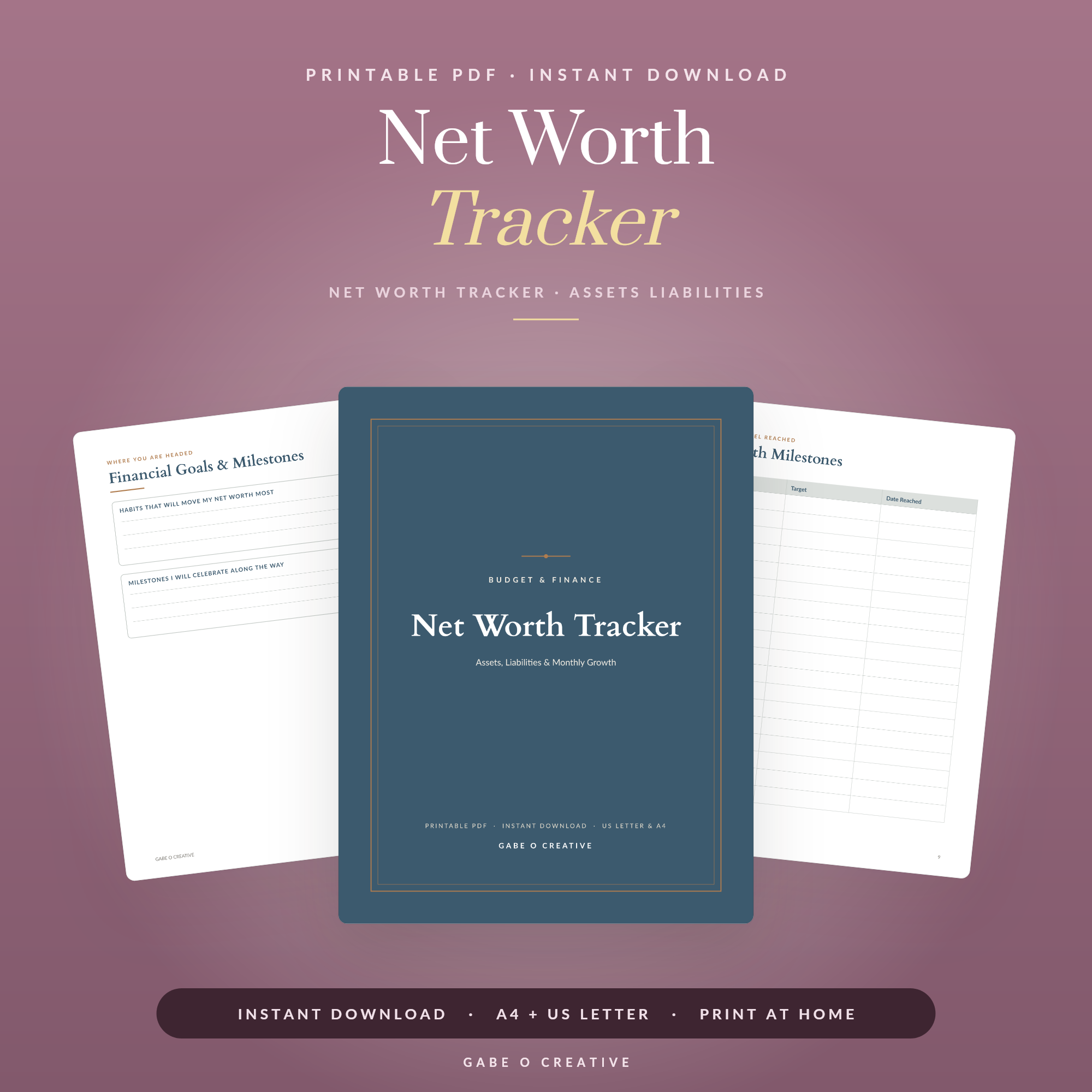
The Net Worth Tracker is calm, simple and tactile. You fill it in by hand each month, which makes you slow down and actually look at your figures. It's perfect if you like pen and paper, want something to keep in a binder, or just prefer working it out by hand. Pop it into an app like GoodNotes on a tablet and you can fill it in with a stylus, no printer required.
Each month you list your assets and liabilities, subtract one from the other, and write the result on the monthly log with the date. Over a few months those entries line up into a trend you can see at a glance, and watching that figure climb is what makes all your effort feel worthwhile. Because every page is yours to reuse, you simply print a fresh sheet whenever you need one and keep the habit going for as long as you like.
Either way, your net worth tracker works best alongside a budget that creates the spare cash to grow it. Pair it with the Budget & Finance Planner binder for a complete print-and-go system that plans your whole year. Want the lot? The Budget & Finance bundle includes the tracker, budgets and more at the best value.
 Shop Net Worth Tracker →
What If Your Net Worth Is Negative?
First, breathe—a negative net worth is completely normal and not a sign you've done anything wrong. If you have a mortgage, student loans, or you're in the thick of paying off debt, your liabilities can easily outweigh your assets for years. Plenty of people with good incomes and bright futures have a negative number on paper today.
What actually matters is the direction of travel. A net worth of minus £15,000 that's climbing towards zero each month is a success story in progress. The tracker's real job here is to show you that the gap is closing—and watching a negative number shrink is every bit as motivating as watching a positive one grow. If debt is what's holding you back, our guide to the debt snowball tracker printable pairs perfectly with this one: clear the debt, and your net worth turns the corner.
For the full toolkit, see our roundup of the best budget planner printables, and to put your numbers to work, our guide to the monthly expense tracker shows how to free up the spare cash that grows your net worth.
Net Worth Tracker FAQs
What is net worth?
Net worth is everything you own minus everything you owe—your assets minus your liabilities. It's a single number that captures your true financial position better than your salary or any one account balance.
How do I calculate my net worth?
Add up the value of all your assets (cash, savings, investments, property, your car), then subtract all your liabilities (mortgage, loans, credit cards, overdrafts). Whatever's left is your net worth.
How often should I update my net worth tracker?
Once a month is the sweet spot. It's frequent enough to spot trends and stay motivated, but not so often that normal market wobbles or a single big bill make you anxious.
Is it bad if my net worth is negative?
Not at all—it's completely normal, especially if you have a mortgage, student loans or are early in paying off debt. What matters is the direction of travel: a negative number climbing steadily towards zero is real progress.
Should I track my net worth by hand or in an app?
A printable log is simple, calming and great for monthly check-ins by hand, and seeing the figure in your own writing makes the progress feel real. If you would rather it did the maths for you, a budgeting app on your phone works too. Many people start with the printable and add an app later.
Does my house or car count towards net worth?
Yes—any asset you could realistically sell counts at its current market value. Just remember to also list the matching debt (like your mortgage or car finance) on the liabilities side so the picture stays honest.
Ready to find your number? Grab the net worth tracker and log your first month today, or explore the full Budget & Finance collection for everything you need to take control. The sooner you start, the sooner you'll see the trend.