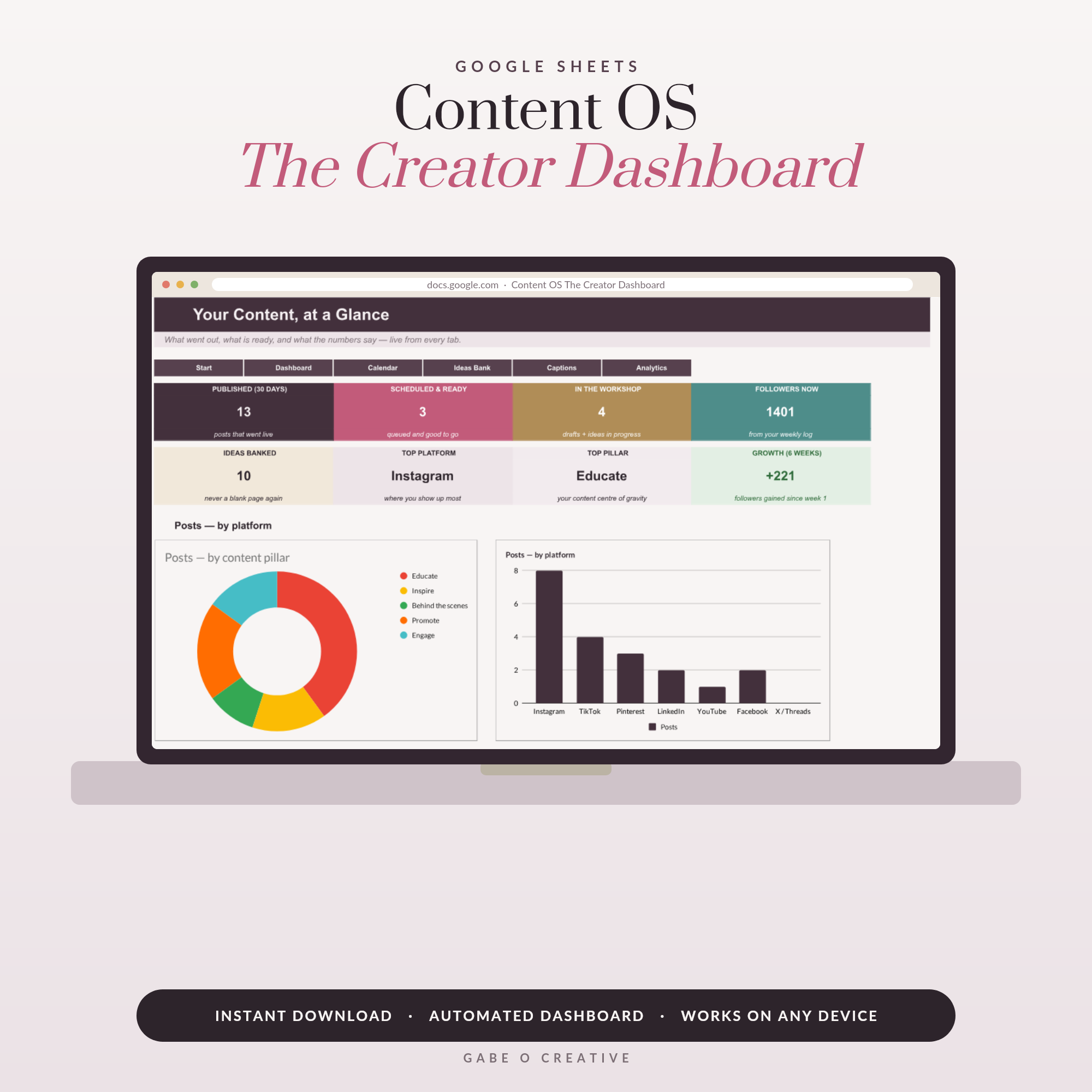
Here's the thing nobody says out loud: consistent posting isn't a discipline problem. It's a decisions problem. Every evening you're asked to invent a topic, write it, design it and publish it — four hard jobs, at the worst hour, from nothing. A social media content calendar fixes it by moving all the deciding into one calm sitting, so daily posting becomes copying from a list. The Social Media Content OS is that list, running itself.
Want the system ready-made? The Social Media Content OS is a Google Sheets planner with pillars, an idea bank, a month-at-a-glance calendar and performance tracking — plan once, post all month.
Step 1 — pick four pillars (this is the whole trick)
A pillar is a theme you post about, so you're never facing a blank page. Four is the sweet spot. For a small shop they might be:
- Teach — something genuinely useful, free, no strings (this builds the trust everything else spends)
- Show — the product doing its job, the process, the behind-the-scenes
- Story — why you make this, who it's for, the honest bits
- Sell — the clear ask. Roughly one post in five, and it works because the other four earned it
Now planning is no longer inventing. It's choosing: “Monday's a Teach — what do I know that helps?” That's a completely different, much cheaper mental act.
Step 2 — the batch day, in three separate modes
The reason batching fails is mode-switching. Writing, designing and scheduling use different parts of your brain, and flipping between them is what turns six hours into four days. So do them in blocks, in this order:
| Block | What you do | Time |
|---|---|---|
| 1 · Plan | Fill the month's grid from your idea bank — pillar + hook only, no writing | 45 min |
| 2 · Write | Every caption, back to back. Bad first drafts allowed | 2 hours |
| 3 · Design | Every graphic in one run, in one template set | 2 hours |
| 4 · Schedule | Load the lot into Buffer/Later/Meta and close the laptop | 45 min |
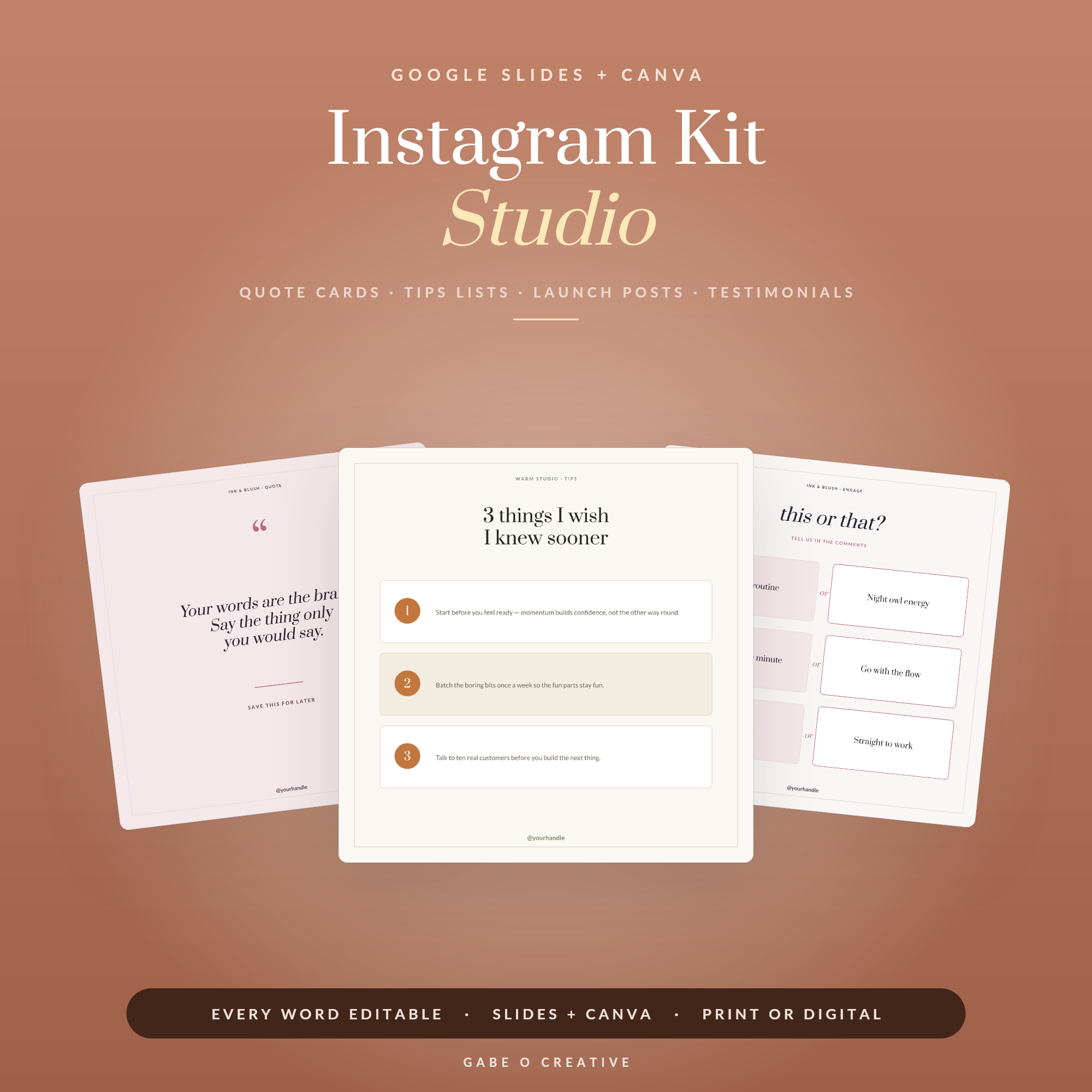
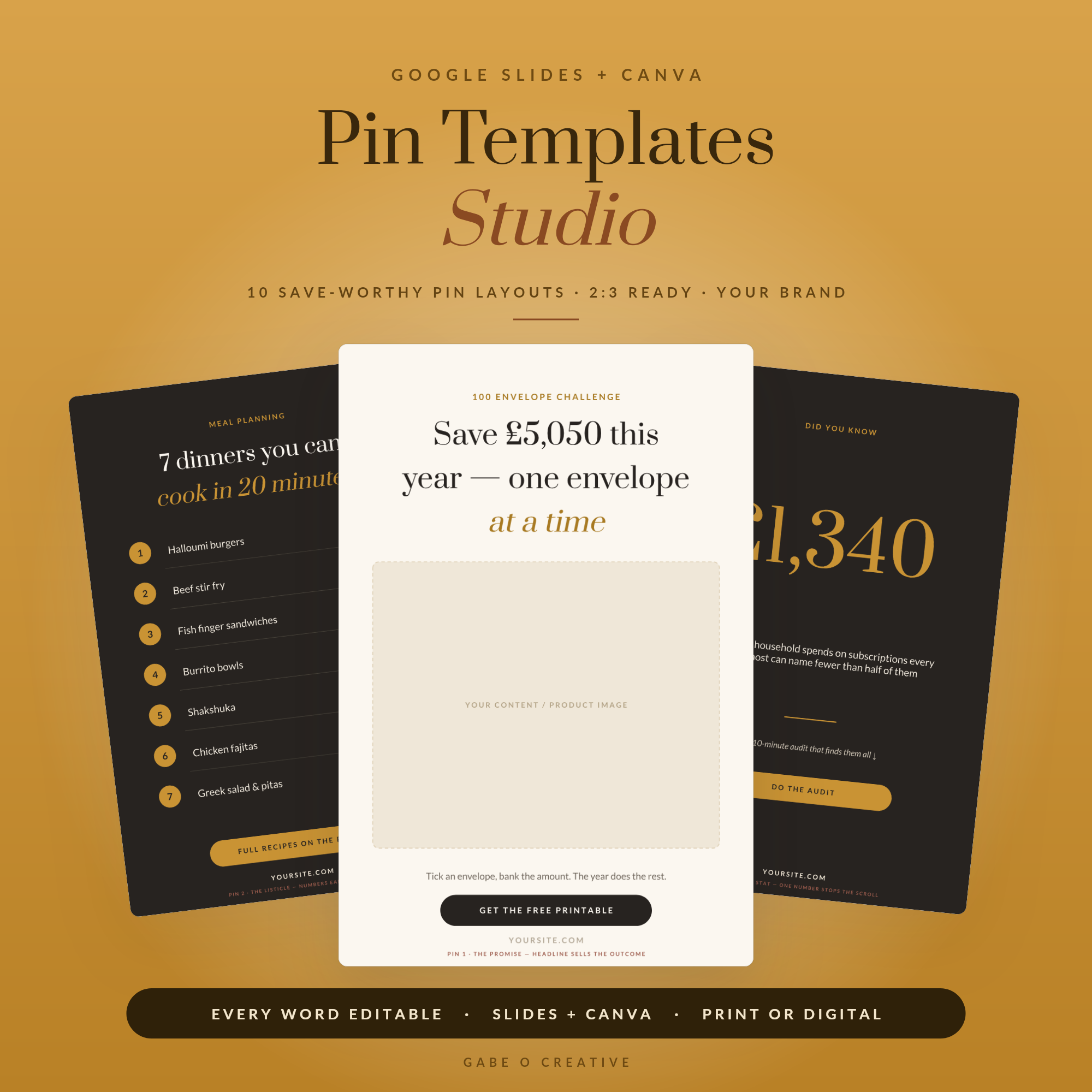
That's a month, done, in about six hours. Design goes fastest when you're not designing from scratch — our Instagram Kit Studio gives you 15 matching post layouts to type over, and the Pin Templates Studio does the same for Pinterest.
Step 3 — one idea, nine outfits
The highest-leverage habit in content: stop making nine ideas and start making one idea nine ways. Take a single useful thing — say “the 100 envelope challenge saves £5,050” — and dress it differently: a carousel breaking down the maths, a quote card, a story poll (“could you do envelope 87?”), a reel with the grid filling up, a text post about the psychology, a before/after of the savings pot. Nobody sees all nine. The one that flies tells you what your audience actually wants next month — which is real data, not guessing.
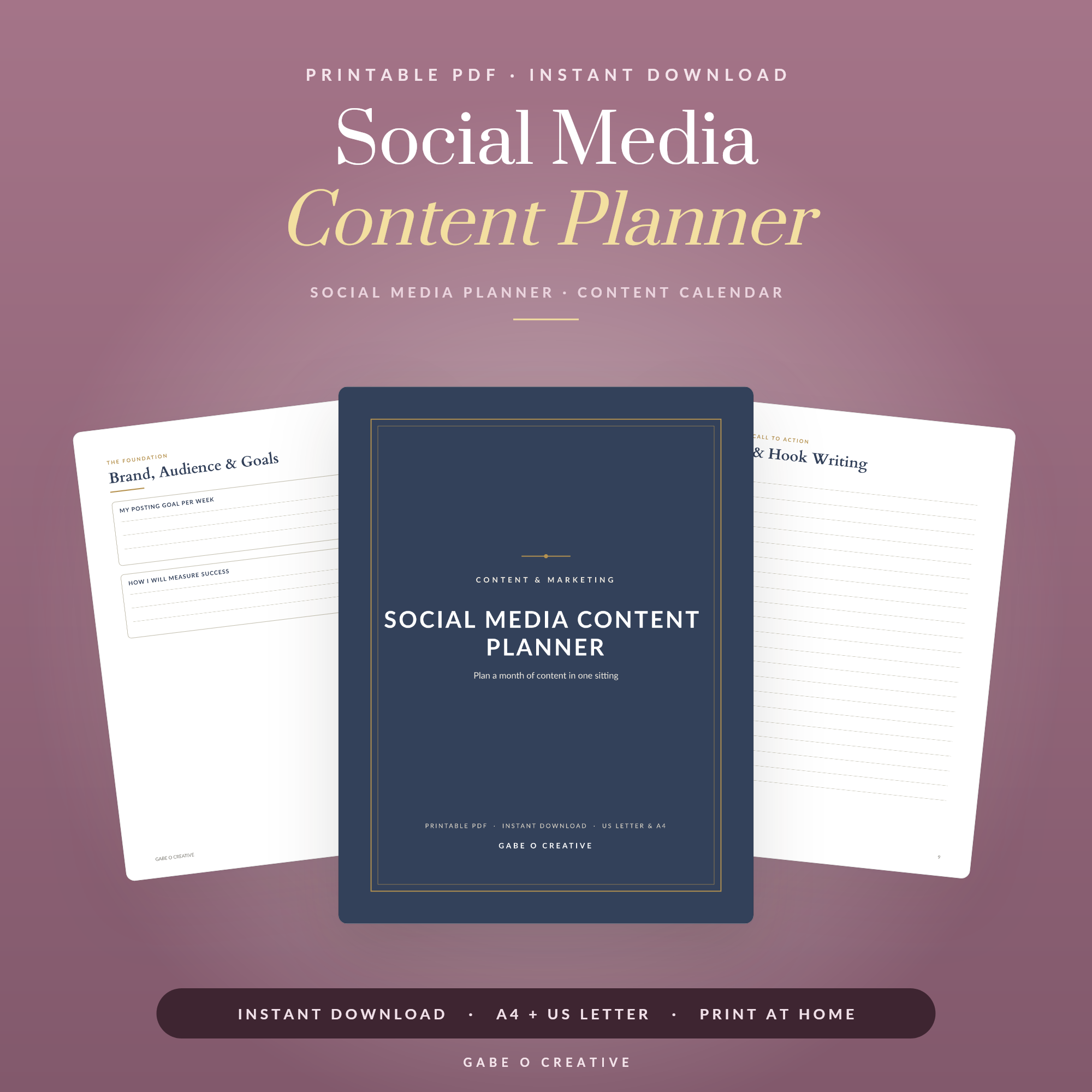 Shop Social Media Content Planner →
Step 4 — capture, so batch day has a full menu
Batch day is only easy if you arrive with ideas. Keep one always-open note — phone, app, anywhere — and every time a customer asks a question, or you explain something twice, or a post idea hits in the shower, it goes in. Untouched, unsorted. By batch day you have a menu instead of a blank page. The Content OS has this as its idea bank tab, tagged by pillar, so plan-block becomes twenty minutes of picking.
Step 5 — track what worked (five minutes, monthly)
Log the numbers that matter — not vanity views but saves, shares and clicks, because those are the ones that mean “this was worth someone's time.” After two months you'll see a pattern: a pillar that always outperforms, a format your audience loves, a posting time that lands. Then you stop guessing forever. That's the quiet superpower of a calendar over a scattergun — it turns posting into a feedback loop instead of a coin flip.
The cadence rule that saves careers
Pick the number you can hit on your worst week, not your best. Three posts a week held for a year beats seven a week held for a fortnight and then six months of silence — and the second pattern is the one that makes people quit, because “failing” at your own plan feels awful. Set the floor low enough that you always clear it. Good weeks then feel like winning instead of the baseline you're falling short of. If you're pitching brands off the back of your consistency, our Media Kit Studio turns those numbers into something you can send.
Why the calendar beats 'posting when inspired'
Inspiration is a wonderful thing and a terrible schedule. It arrives on good weeks, in good moods, when nothing else is on fire — which is precisely when your business least needs saving. The calendar isn't there to replace inspiration; it's there for the fortnight when inspiration doesn't show up, so the shop keeps talking anyway. Every creator who has grown steadily has some version of this system, and every one who burned out was, at some point, relying on feeling like it.
The 20-minute weekly top-up
One habit keeps the calendar alive between batch days: a Friday scan. Twenty minutes, once a week — reply to every comment you missed, note which post did unusually well or badly, and drop any new ideas into the bank. That's it. The batch day builds the month; the Friday scan keeps it honest and stops the calendar drifting away from what your audience is actually responding to. Skip it and by week three you're publishing into a void you stopped listening to.
Your questions, answered
What is a social media content calendar?
A single place where every post is decided before it's needed: the date, the pillar it serves, the hook, the format and the call to action. The point isn't the grid — it's that all the deciding happens once, in a calm hour, instead of every day at 8pm when you're tired and staring at a blank caption box.
What are content pillars and how many should I have?
Pillars are the three to five themes you post about, so you're never inventing from nothing. A shop might run Teach, Show, Story and Sell. Four is the sweet spot: enough variety that the feed breathes, few enough that planning is choosing rather than inventing.
How far ahead should I plan social media content?
One month is the honest answer for most small businesses — far enough that a bad week can't take you offline, near enough that you're still reacting to real life. Quarterly plans look impressive and die by week three.
How do you batch a month of content in one day?
Separate the modes: plan (pick the posts), create (write and design them all in one run), schedule (load them), then live your month. The trick is never mixing the three — swapping between writing and designing and posting is what makes it take four days instead of six hours.
How do you turn one idea into multiple posts?
Take a single genuinely useful idea and change only the outfit: the carousel, the quote card, the story poll, the reel hook, the text post, the before/after. Same message, six formats — nobody sees all six, and the one that lands tells you what your audience actually wants.
How often should I actually post?
Whatever cadence you can hold on a bad week — three consistent posts beat seven for a fortnight then silence for a month. Pick the floor you can always hit, then let good weeks be a bonus rather than the standard you're failing against.
More for the creator stack: our guides to building a media kit and running a small business on Google Sheets, plus the printable Social Media Content Planner if you'd rather plan on paper.
Stop deciding at 8pm. Copy the Social Media Content OS, fill the pillars once, and post from a list all month.