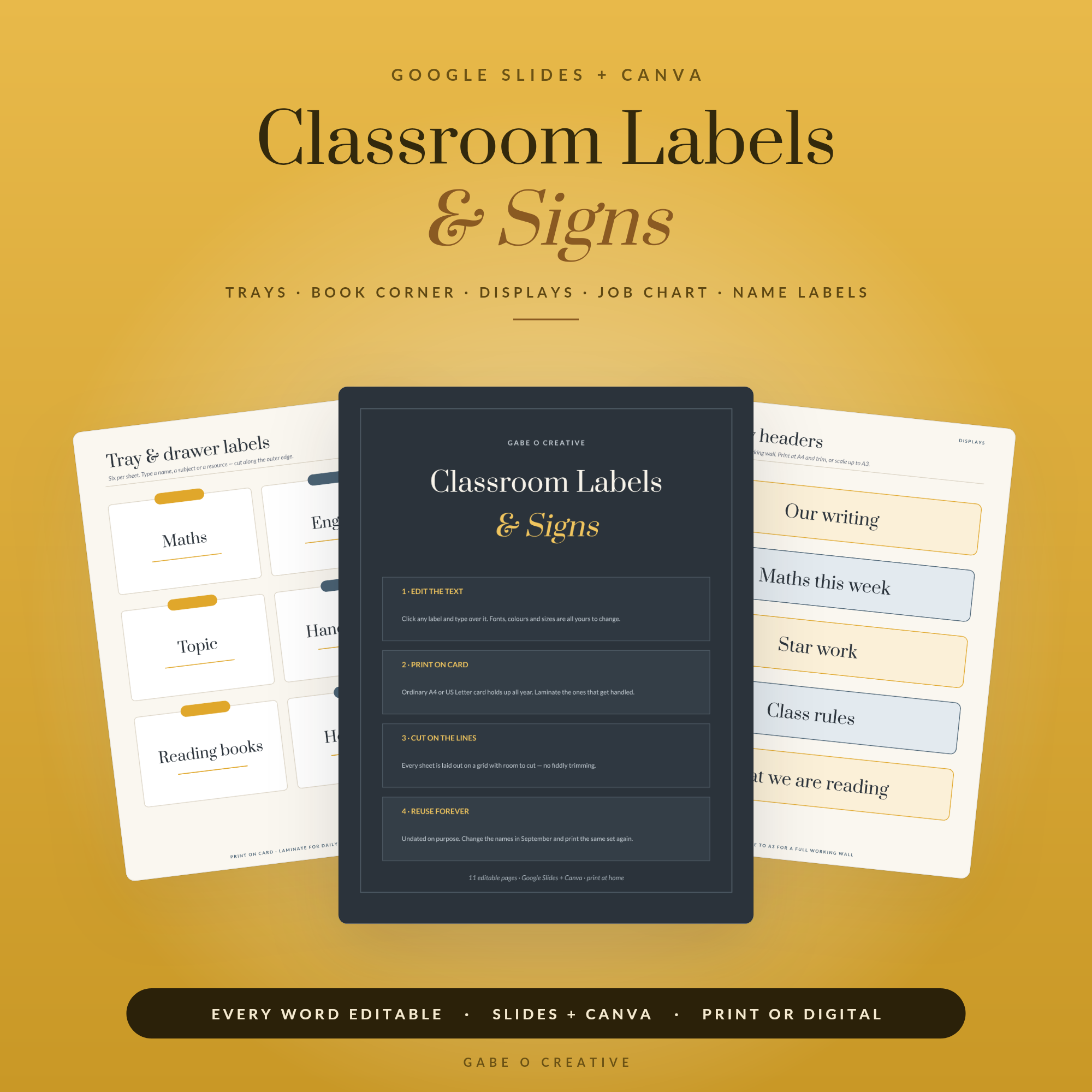
Good classroom labels are not decoration. They are the quiet answer to every question a child would otherwise ask you — where does this go, which tray is mine, what am I supposed to be doing now — and a well-labelled room hands those answers back to the children instead of routing all of them through you. That is the real return on an afternoon of printing and cutting. If you want the whole set ready to edit, the Classroom Labels & Signs Studio covers every surface in one design family.
Setting up a new room this term? The Classroom Labels & Signs Studio gives you eleven editable pages — trays, book corner, shelves, tables, displays, door and job chart — all matching, all reusable every September.
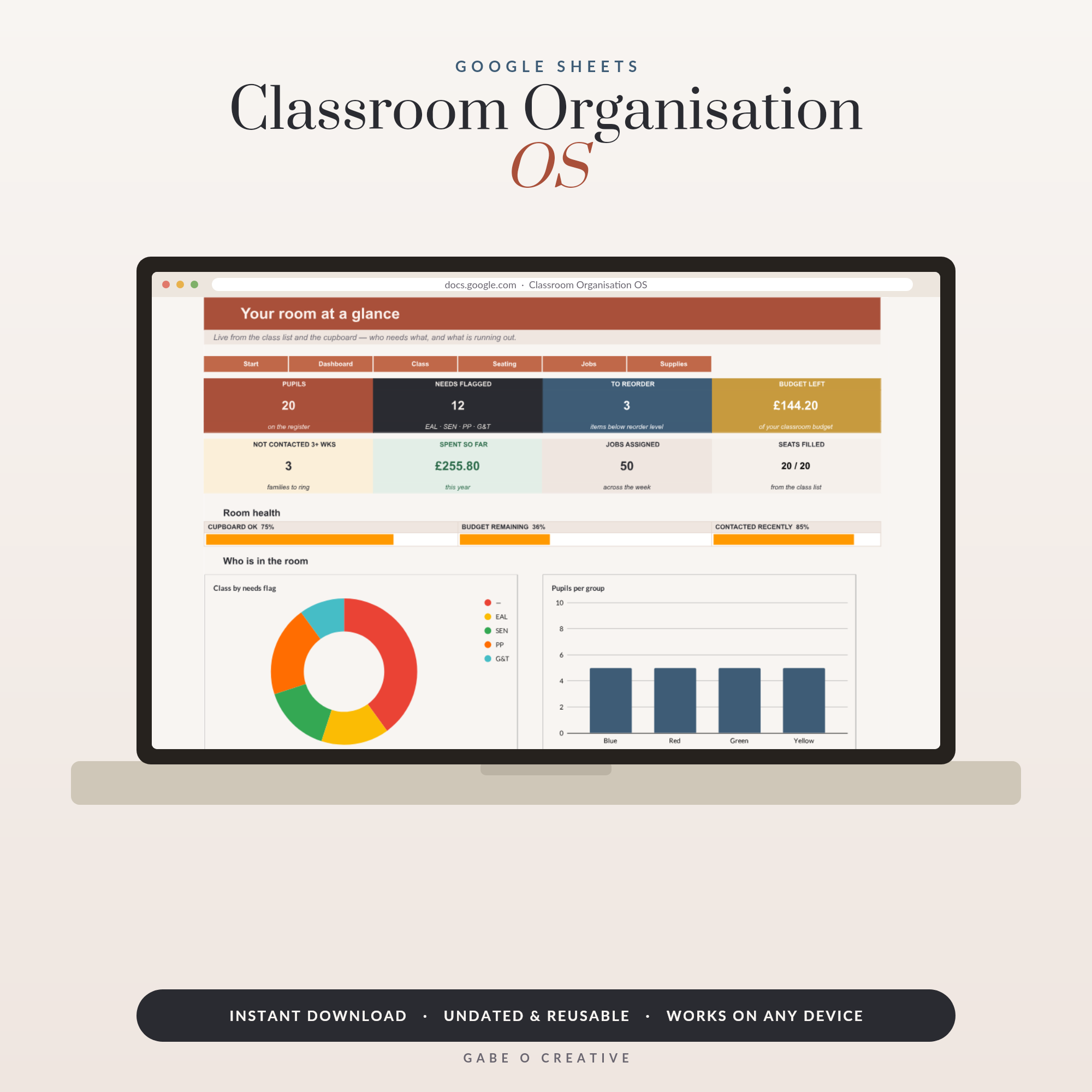 Shop Classroom Organisation Google Sheets Template, Teacher Class List & Seating Plan Spreadsheet with Job Rota, Supplies Inventory & Budget Tracker →
What Classroom Labels Actually Have to Do
A label earns its place if it does one of three jobs. It tells a child where something lives, so tidying stops being a negotiation. It tells them what to do, so routines run without you narrating them. Or it tells an adult who is not you — a cover teacher, a TA, a parent helper — how the room works, which is the job most people forget until the morning they are off sick.
That third one is worth dwelling on. A room that only makes sense to the person who built it is a fragile room. The test is simple: could someone who has never taught in your classroom find the spare glue sticks, seat the children correctly and run the end-of-day jobs, using only what is on the walls? If not, the gaps are your labelling list.
Why matching matters more than pretty
Nine labels downloaded from nine different places will always look like nine different downloads, and the room reads as busy rather than calm. Consistency does more visual work than any individual design: one font, one accent colour, one shape repeated across every surface. Children read a consistent system faster too, because the format itself becomes a cue.
The Labels Every Room Needs
Start with these, in roughly this order of return:
- Tray and drawer labels — the highest-traffic labels in the room, and the ones that stop the daily where-does-this-go queue.
- Book corner labels — sort by genre rather than author and books actually find their way home.
- Shelf and storage signs — bigger, for cupboards, the art trolley and the wet-play box.
- Table or group signs — fold-over tents work better than flat cards because they are readable from standing height.
- Display headers — banner strips for the working wall, so a display looks finished in two minutes.
- Door or welcome sign — the one visitors, supply staff and new parents use.
- Job chart — the labels that hand the running of the room to the children.
- Name labels — pegs, trays, drawers and lunchboxes, twenty to a sheet.
Words, pictures, or both
In Reception and Key Stage 1, pair every word with a small picture. A child who cannot yet read "scissors" can still put the scissors away independently, and independence is the entire point of the system. By Key Stage 2 the picture becomes clutter — clear words are enough, and you can use the space for a fuller description instead.
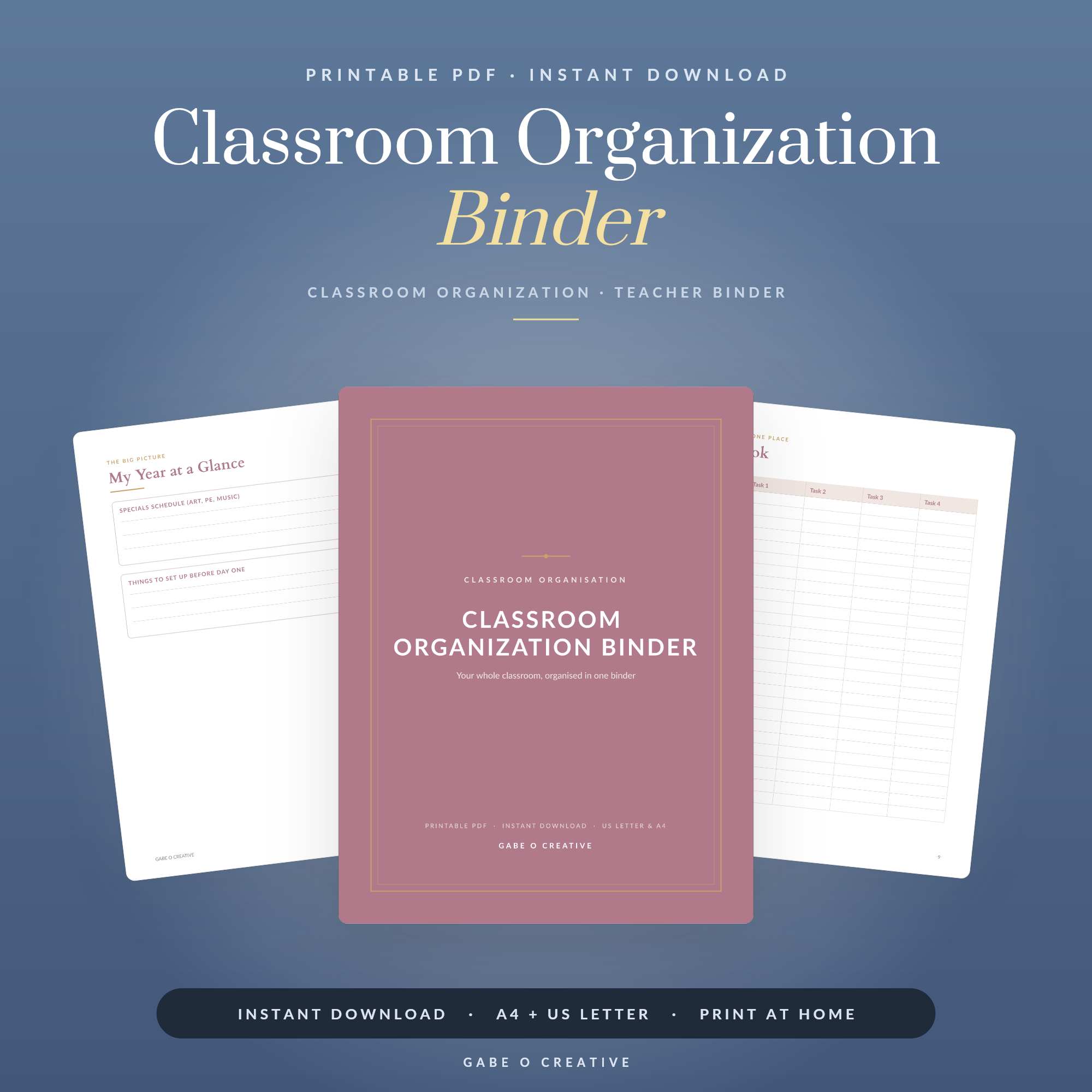 Shop Classroom Organization Binder →
Printing Them So They Survive the Year
The most common labelling mistake is treating every label the same. A door sign printed once and never touched needs nothing special; a tray label handled thirty times a day needs card and lamination. Match the material to the wear:
| Label | Paper | Laminate? | Fixing |
|---|---|---|---|
| Tray & drawer labels | 160gsm card | Yes | Foam pads or label pockets |
| Book corner labels | 160gsm card | Yes | Sticky-back plastic or pockets |
| Shelf & storage signs | 160gsm card | Optional | Blu-tack or magnetic tape |
| Table tents | 250–300gsm card | Yes | Free-standing, folded |
| Display headers | Ordinary paper | No | Staples |
| Door / welcome sign | 250gsm card | Optional | Command strip |
| Name labels | Sticker paper or card | No | Peel and stick |
Two practical notes. Laminating pouches are the single biggest consumable cost in most classrooms, so laminate selectively rather than reflexively — it is also the greener choice. And print names on sticker paper rather than laminating them, because names change and laminated names do not come off.
Signs That Do the Teaching for You
The strongest signs in a classroom are the ones that replace an instruction you would otherwise repeat. A job chart on the wall at child height means the end-of-day routine runs itself. A rules poster agreed in week one gives you something to point at rather than a speech to make. A "what to do if you are stuck" sign near the working wall diverts a genuine chunk of hands-up traffic.
Put them where the behaviour happens, not where there is a convenient gap on the wall. The tidy-up expectations belong above the trays. The line-up order belongs by the door. A sign three metres from the moment it describes is a poster; a sign at the moment itself is a system.
Setting Up in an Afternoon
Work in batches rather than finishing one label at a time. Type all your wording first — that is the part that needs your brain — then print everything in one go while you get on with something else, then cut, then fix. An hour of typing, an hour of printing and cutting, an hour of putting up, and the room is done.
Once the labels are up, the natural next step is the system behind them: who sits where, who does which job, and what the cupboard is running out of. Our guide to classroom organisation ideas covers the wider setup, and if you would rather have that running in a spreadsheet, the Classroom Organisation OS holds your class list, seating plan, job rota and supplies inventory in one place, with the labels printing from the same names. New to a room this year? Pair it with our classroom setup checklist and the first day of school checklist. For the lesson side rather than the room side, the Teacher Planner for Google Sheets and the printable classroom organisation binder both pick up where the labels stop, and the teacher classroom kit adds newsletters and certificates in the same editable format.
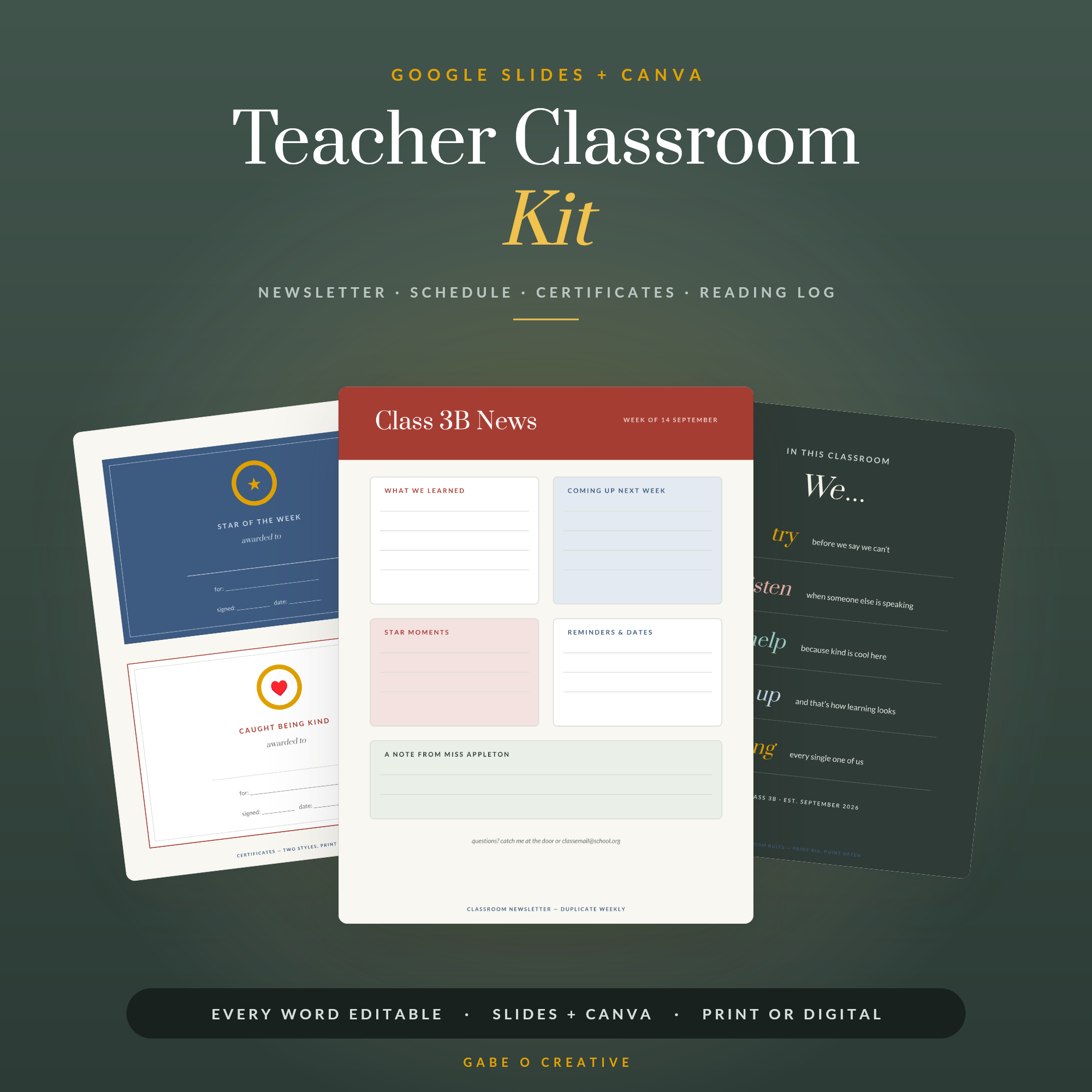 Shop Teacher Classroom Kit — Editable Classroom Newsletter, Schedule, Certificates, Name Labels, Reading Log & Parent Notes for Google Slides & Canva →
Classroom Labels FAQs
What should I label in a classroom?
Anything a child might otherwise ask you about: trays and drawers, book corner sections, shelves and storage boxes, tables or groups, display headers, the door, and the classroom job chart. If a question comes up more than twice a week, it wants a label.
Should classroom labels have pictures as well as words?
In early years and lower primary, yes — a small picture lets children who are not yet reading fluently use the system independently, which is the whole point. From upper primary onwards, clear words on their own are usually enough.
What paper should I print classroom labels on?
Ordinary 160gsm card is fine for most labels. Use 250–300gsm for anything that stands up, like table tents, and laminate only the things that get handled daily — trays, job charts and drawer fronts.
How do I stop labels falling off?
Match the fixing to the surface: double-sided foam pads on plastic trays, magnetic tape on metal, and blu-tack only on painted walls where you plan to move things. Sticky labels on fabric-covered display boards will always fail — staple those.
Are editable labels better than ready-made ones?
Yes, for one practical reason: your subjects, groups and storage never quite match somebody else's. An editable set lets you type your own wording and reprint a single label when a tray changes, instead of buying a whole new pack.
How long does labelling a classroom take?
One afternoon if you print in batches. Roughly thirty minutes typing your wording, an hour of printing and cutting while you do something else, and an hour putting them up.
Ready to do the whole room at once? Open the Classroom Labels & Signs Studio, type your own wording over eleven matching pages, and print the set this weekend — or browse the full Students & Teachers collection for the rest of the setup.