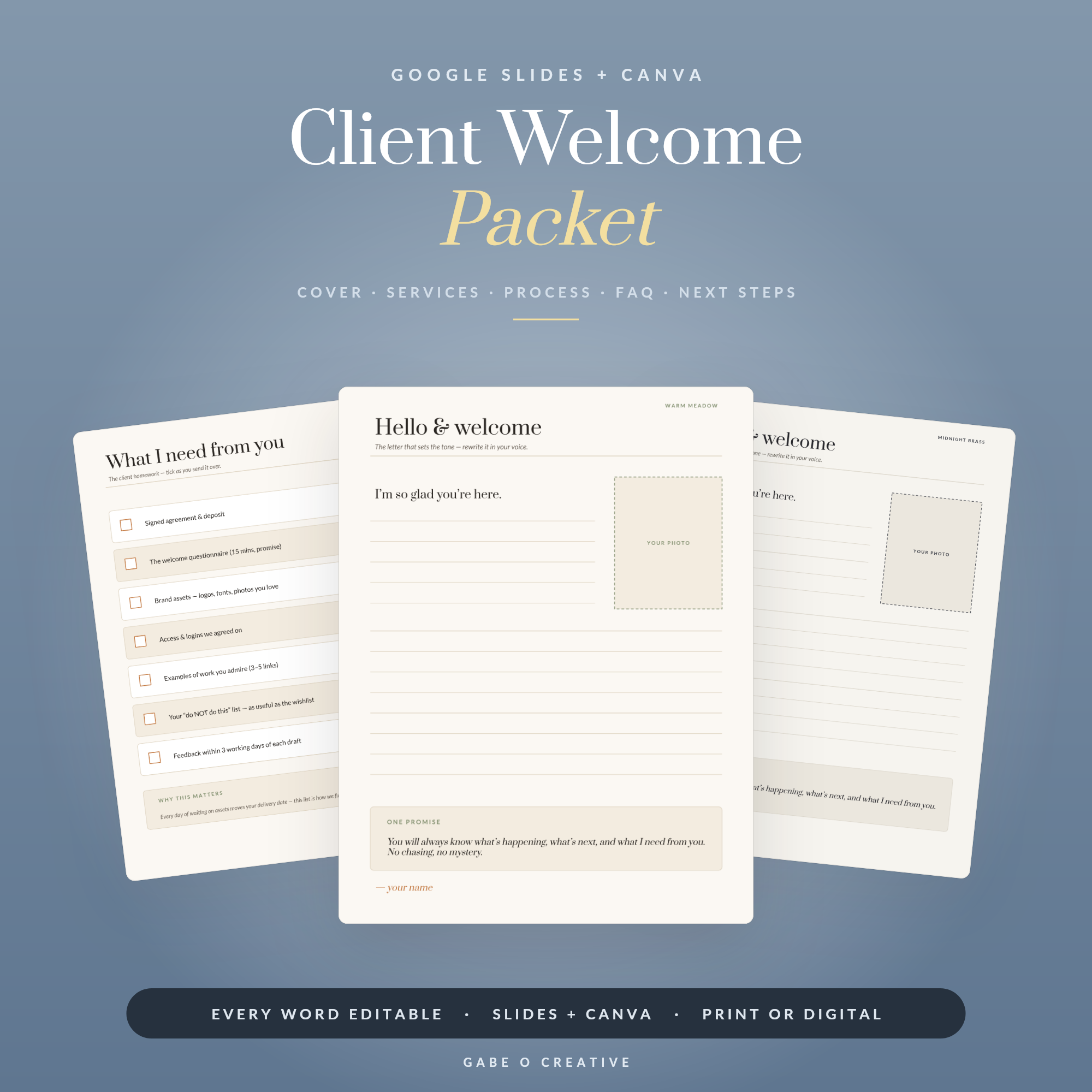
A great client onboarding process is the difference between looking like a studio and looking like a person winging it — and it's decided in the 48 hours after the client says yes. Handled well, those hours produce a client who trusts your process, respects your boundaries, pays your deposit without blinking and refers you to friends. Handled with silence and improvisation, they produce the ghosting, the scope creep and the 'just one more tweak' spiral every freelancer knows. This guide is the six-step process from yes to wow — including the one document that does most of the work: the welcome packet. Ours, the Client Welcome Packet for Google Slides and Canva, is seven pages you customise once and reuse for every client, forever.
Want the packet built tonight? The Client Welcome Packet has the welcome letter, process timeline, checklist and FAQ pre-written — type over the examples with your details.
Why onboarding decides the whole project
Every project problem you've ever had — late feedback, moving goalposts, invoices chased for weeks — traces back to expectations that were never set. Clients aren't difficult by nature; they're uncertain, and uncertain people improvise. Onboarding is where you replace uncertainty with a process: what happens when, who does what, how communication works, what things cost when they change. Do that in the first 48 hours, while goodwill is at its peak, and the rest of the project mostly runs itself. It's also, quietly, a sales tool — a polished onboarding experience is the thing clients describe when they refer you: 'she made it so easy'.
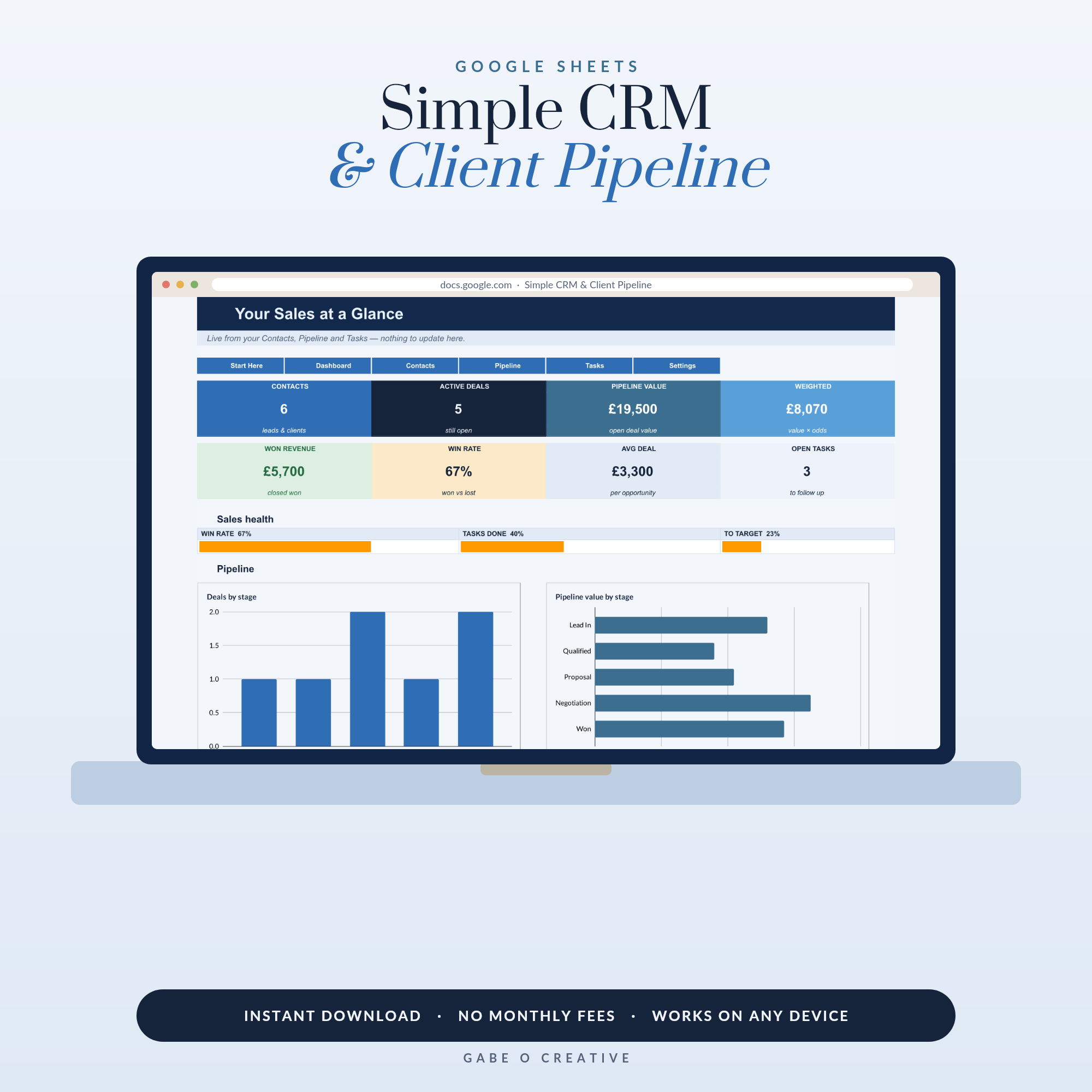 Shop Simple CRM & Client Pipeline, Google Sheets Template, Sales Tracker, Lead & Deal Pipeline, Small Business CRM →
The six steps, from yes to kickoff
The rhythm that works, over 3–5 working days:
| Step | When | What happens |
|---|---|---|
| 1 · The same-day reply | Day 0 | Thank them, confirm the decision, say exactly what happens next |
| 2 · Contract + deposit | Day 0–1 | Agreement and 30–50% invoice — work is scheduled when both land |
| 3 · Welcome packet | On payment | Process, timeline, communication rules, FAQ — the expectations document |
| 4 · Kickoff questionnaire | Day 1–3 | Everything you need from them, asked once, with a deadline |
| 5 · Kickoff call | Day 3–5 | Align on scope, success and the first milestone — 30 minutes, agenda'd |
| 6 · First visible win | Week 1 | A small deliverable early — momentum makes clients relax |
Notice what step 2 does: the deposit isn't just cash flow, it's a filter and a tone-setter. Serious clients pay it promptly; the ones who vanish at the invoice were going to vanish anyway — better now than mid-project. And never let silence follow the yes: momentum is the real product of onboarding, and every quiet day lets doubt grow.
The welcome packet: your process, in writing
The packet is the highest-leverage document in freelancing because it's built once and answers questions forever: how the project flows step by step, when they'll hear from you and through which channel, your office hours (boundary-setting without the awkward conversation), what you need from them and by when, what a revision round includes, and the FAQ you'd otherwise answer by email a hundred times. Sending it as a designed PDF minutes after the deposit clears is the 'wow' moment — clients suddenly realise they've hired someone with a system. The Client Welcome Packet studio ships all seven pages in two themes with the awkward parts (payment terms, revision limits, communication rules) already drafted in friendly-but-firm language — you adjust rather than compose.
The scope-creep vaccine
Somewhere in the packet and the kickoff call, scope gets defined in writing: deliverables, revision rounds, and — crucially — what's not included. Then when the mid-project 'could we also…' arrives, you have the gentle script: 'Great idea — that's outside our current scope, so I'll quote it separately so we can keep this phase on schedule.' No conflict, no resentment, no free work. Scope creep is not a client problem; it's a vagueness problem, and onboarding is where vagueness dies.
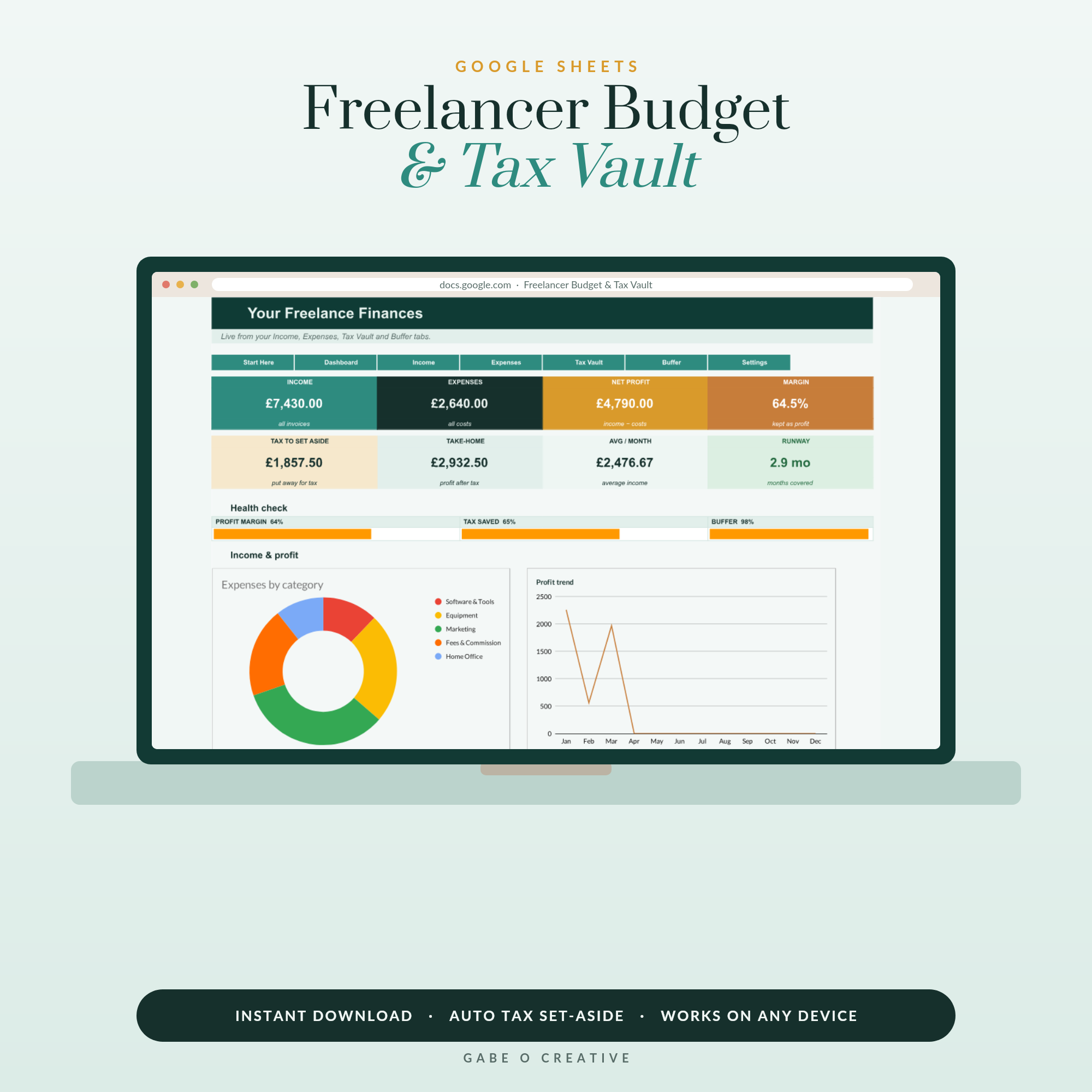 Shop Freelancer Budget & Tax Vault, Google Sheets Template for Self-Employed, Irregular Income Planner, Tax Set-Aside Tracker →
The systems behind the smile
Onboarding runs on reused pieces, so build each once: the packet, the questionnaire, the contract template, the kickoff agenda, and a pipeline that remembers where every lead and client stands — that last one is the Simple CRM & Client Pipeline's job (our CRM guide shows the method). Money-side, the deposit-then-milestones structure feeds straight into the Freelancer Budget & Tax Vault, which sets aside tax per invoice so HMRC season never hurts. And if your pipeline needs more incoming leads before onboarding matters, a sharp media kit plus the small business toolkit handle the attraction side. The full stack lives in the Small Business collection.
The follow-through that earns referrals
Onboarding has a final act people forget: the offboarding echo. Deliver the final files with a short handover note (what everything is, how to use it), a 'what worked well' question, and — two weeks later — one unprompted check-in. That last touch costs three minutes and produces more referrals than any portfolio update, because it confirms what the onboarding promised: this person has a process, and I was safe inside it. From yes to wow, then from wow to the next yes.
When the client goes quiet mid-onboarding
Sometimes the deposit lands and then the questionnaire sits unanswered for a week. Don't take silence personally and don't stall politely forever — build the nudge into the system: a friendly reminder at day three, and a scheduling clause in the packet ('project timelines begin when your materials arrive') so their delay moves their deadline, not your other clients' work. Said upfront in writing, it never needs saying awkwardly later — one more conversation onboarding has already had for you.
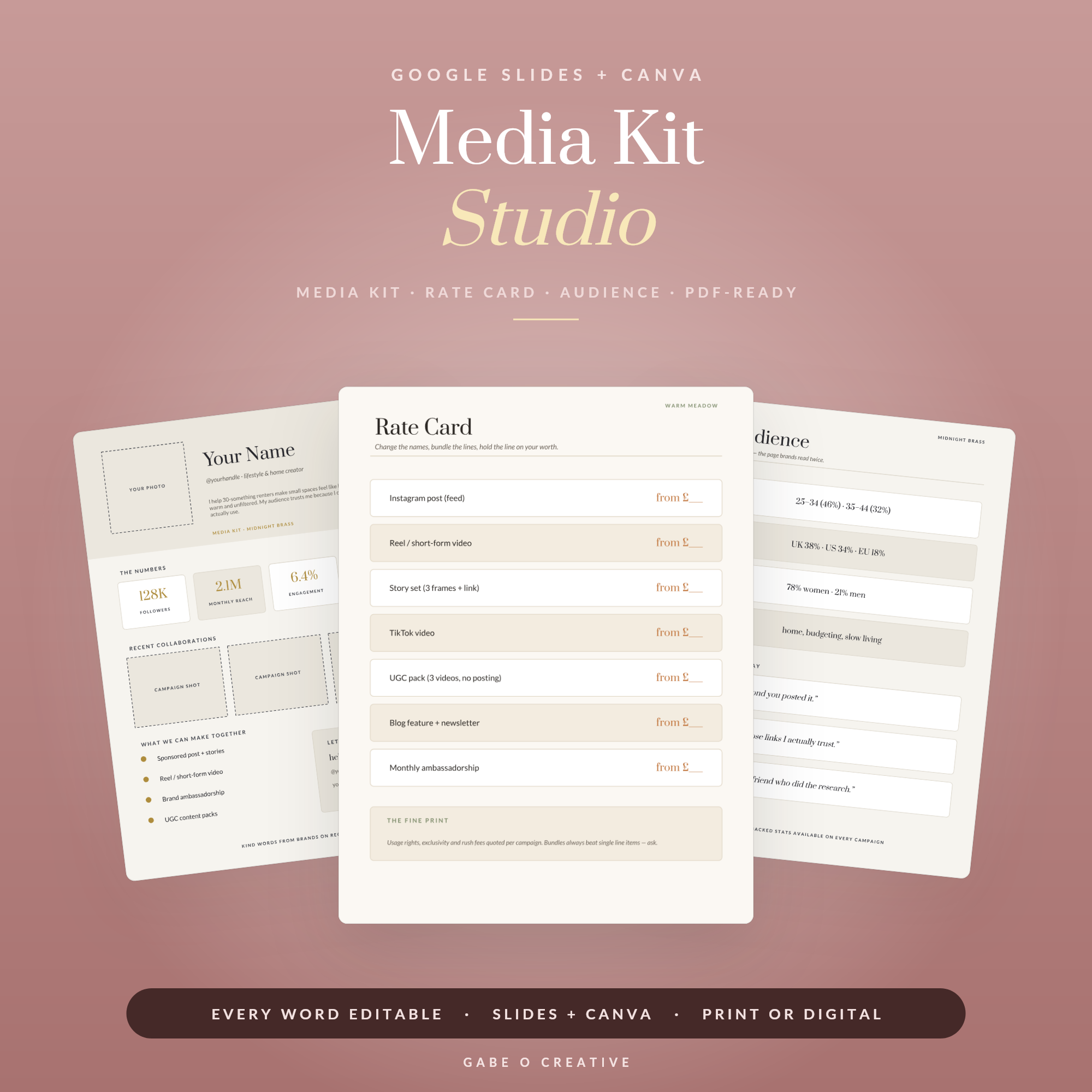 Shop Media Kit Studio — Editable Google Slides + Canva Media Kit for Creators & Influencers: One-Page Kit, Rate Card & Audience Page, 3 Themes →
If you sell on Etsy or your own shop, our bookkeeping for Etsy sellers guide sets up a simple books system that survives tax season.
Frequently asked questions
What should a client onboarding process include?
Six steps: a same-day thank-you with what happens next, the contract and deposit invoice, a welcome packet (process, timeline, communication rules, FAQ), a kickoff questionnaire, a kickoff call to align on scope and success, and a first small deliverable inside week one so momentum is visible.
What goes in a client welcome packet?
A warm welcome note, your services and what they've bought, the project process step by step with rough timings, how communication works (channels, response times, office hours), what you need from them and by when, an FAQ, and next steps. One packet, reused for every client, answers 80% of the questions before they're asked.
Should I take a deposit before starting work?
Yes — 30–50% before anything begins. A deposit filters out non-serious clients, protects your calendar, and sets the relationship's tone: this is a business arrangement, not a favour. Tie the remainder to milestones or completion, and never hand over final files before the final payment clears.
How do I stop scope creep politely?
Define scope in writing during onboarding (deliverables, revision rounds, what's excluded), then use the gentle script when extras appear: 'Great idea — that's outside our current scope, so I'll quote it separately so we can keep this phase on schedule.' Scope creep thrives on vagueness; onboarding is where you remove the vagueness.
How long should client onboarding take?
The admin should take you under an hour per client once systemised — the pieces (welcome packet, questionnaire, contract template) are built once and reused. From yes to kickoff call, 3–5 working days is a healthy rhythm: fast enough to keep excitement, spacious enough to collect what you need.
Why do clients disappear after saying yes?
Usually because nothing happened next. Silence after a yes lets doubt grow — the fix is a same-day reply with the deposit invoice and a clear 'here's what happens next'. Momentum is the onboarding process's real product; every day of quiet costs trust.
Onboard your next client like a studio: the Client Welcome Packet for Google Slides & Canva — seven pages, two themes, every awkward conversation pre-written. Customise once, wow every client after.