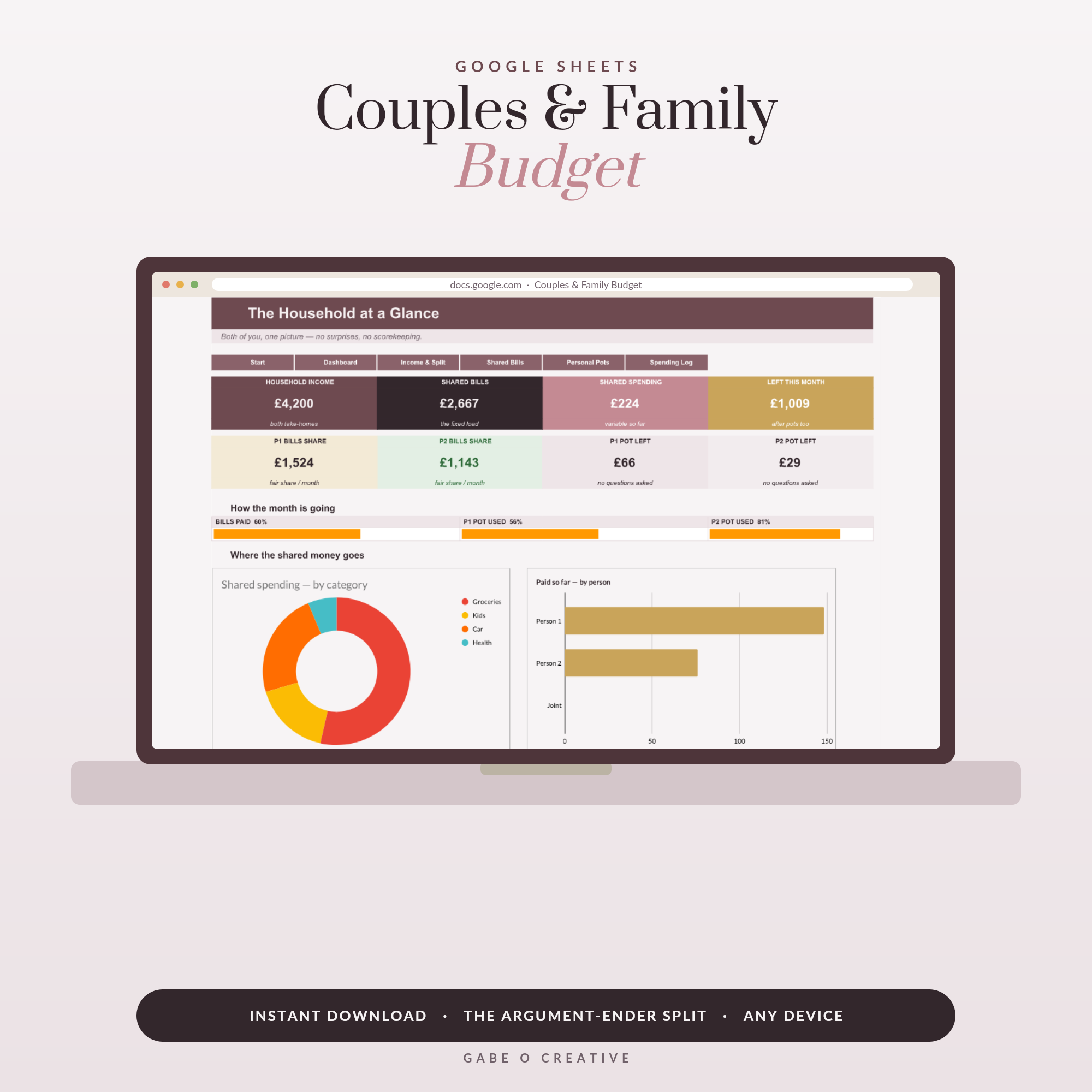
Working out how to split bills as a couple is one of those conversations most people have once, badly, in the first month of living together — and then quietly resent for years. The problem is rarely the amounts; it is that the split was never actually agreed, just assumed. There are three honest ways to do it — equal, proportional to income, and the shared-pot method — and each suits a different kind of couple. This guide walks through all three with real numbers, then shows you the simple setup that makes whichever you choose run on autopilot. Our Couples & Family Budget spreadsheet was built for exactly this: two incomes, one honest plan.
Want the whole system ready tonight? The Couples & Family Budget for Google Sheets handles both incomes, the split maths and the monthly review for you.
Why 50/50 feels fair but often isn't
Equal splitting has one big advantage: it is simple. Rent is £1,400, so you each pay £700, end of discussion. And when incomes are similar, it genuinely is fair. The trouble starts when they are not. Suppose Sam takes home £3,200 a month and Alex takes home £1,800, with £2,000 of shared bills. Under 50/50, Sam pays £1,000 and has £2,200 left; Alex pays £1,000 and has £800 left. They paid the same amount — but nothing like the same sacrifice. One partner books holidays while the other counts days to payday, in the same house, under a split they both once called fair.
That resentment is not a character flaw. It is arithmetic. And it is why the proportional method exists.
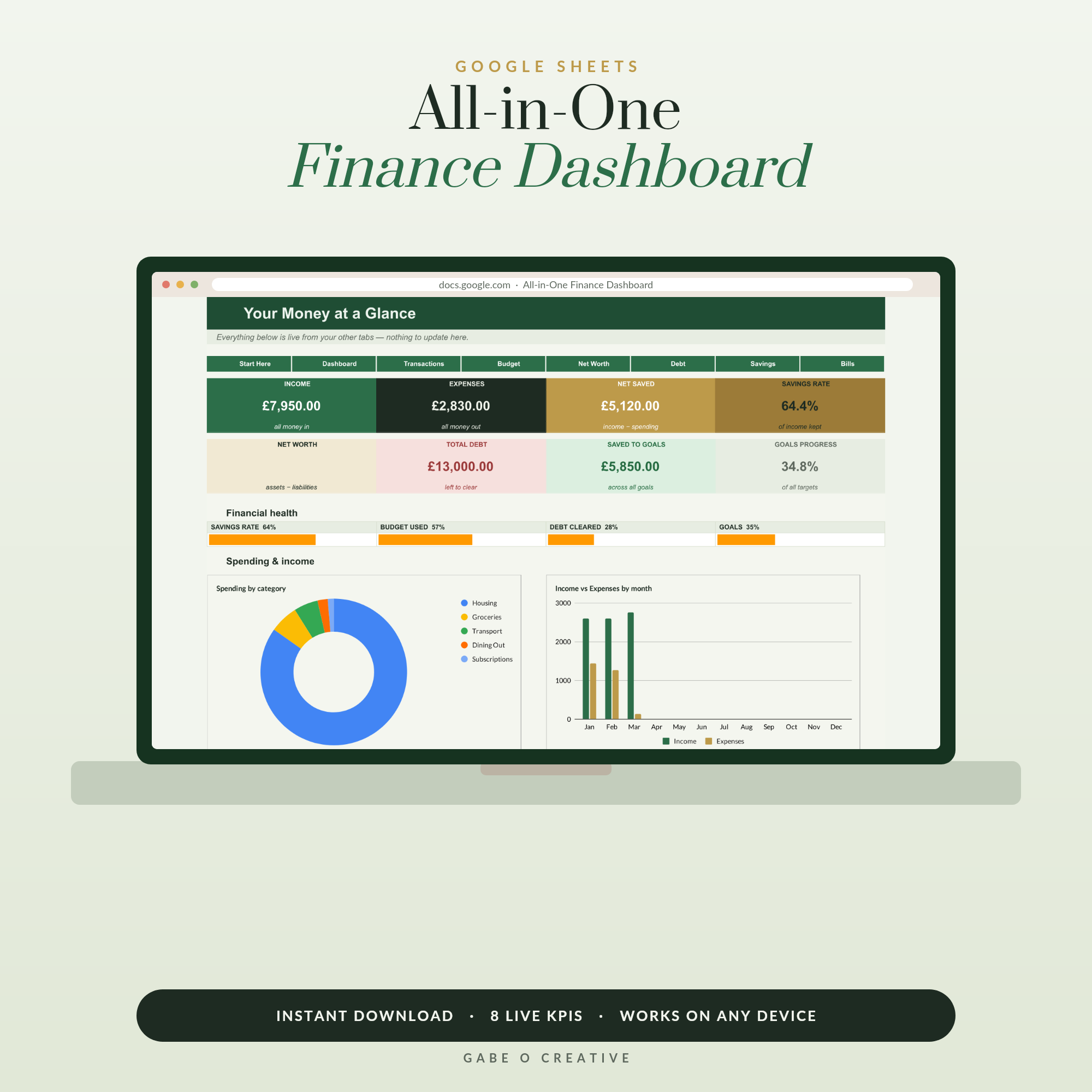 Shop All-in-One Personal Finance Dashboard, Google Sheets Budget Template, Net Worth, Debt Payoff & Savings Goal Tracker →
The proportional method: same sacrifice, not same amount
Proportional splitting means each partner contributes the same percentage of their income to shared costs, not the same number of pounds. The maths takes one minute. Add the take-home incomes: £3,200 + £1,800 = £5,000. Sam earns 64 per cent of the household income, Alex 36 per cent. Apply that to the £2,000 of shared bills:
| 50/50 split | Proportional split | Left over (proportional) | |
|---|---|---|---|
| Sam (£3,200) | £1,000 | £1,280 | £1,920 |
| Alex (£1,800) | £1,000 | £720 | £1,080 |
Both partners now keep the same share of their own income after bills — the sacrifice is equal even though the amounts are not. Most couples who switch describe the same feeling: the low-level unfairness they could never quite name simply stops. The one cost is that somebody has to do the percentage sum whenever incomes change, which is exactly the kind of job a spreadsheet should own. The couples budget recalculates the split automatically when you update either income.
The shared-pot method: transparency plus freedom
The third option changes the question. Instead of splitting each bill, you both pay an agreed amount into a joint account — equal or proportional, your choice — and that pot pays every shared cost: rent, energy, food, insurance, the streaming services you both use. Whatever remains in your personal accounts is yours, entirely, no receipts and no commentary. He can buy the ridiculous gadget; she can buy the fourth pair of near-identical boots; neither is anyone's business.
This method wins on two fronts at once. The essentials are completely transparent — both names, both eyes on one account — while personal spending stays completely private. Most money arguments are actually autonomy arguments, and the shared pot removes the trigger.
Setting the pot amount
List every genuinely shared cost, add 10 per cent for the lumpy ones (annual insurance, car repairs, the vet), and that is the monthly pot. Feed the lumpy costs into sinking funds so December and renewal month never hurt — our sinking funds guide explains the method in five minutes.
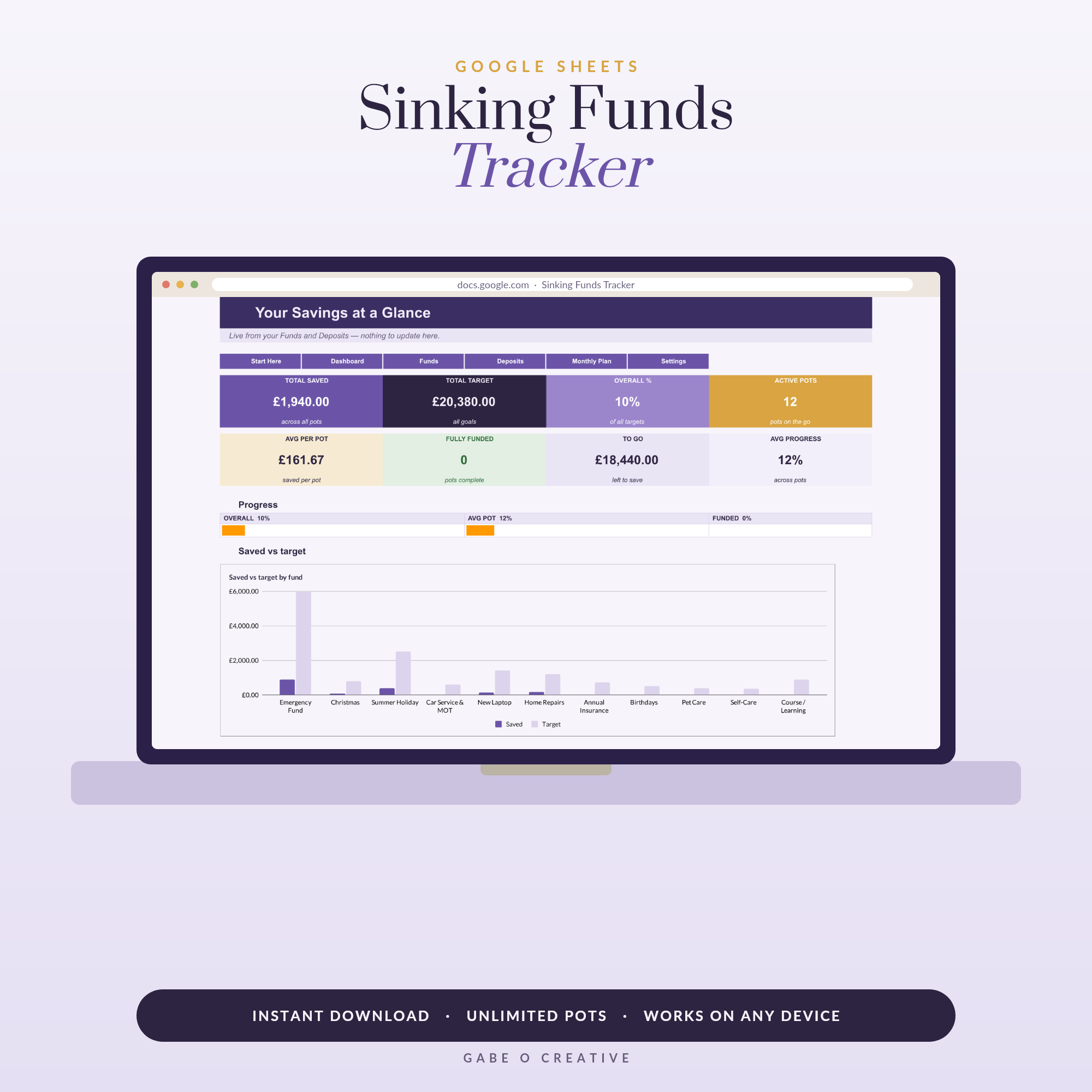 Shop Sinking Funds Tracker Spreadsheet, Google Sheets Savings Template, Multiple Savings Goals, Cash Stuffing & Budget Planner →
The conversations worth having before the maths
Whichever method you pick, three questions decide whether it works. First: what counts as shared? Rent is obvious; her gym membership and his golf are not; groceries live in between. Write the list — the ambiguity is where arguments breed. Second: what happens to debt each partner brought in? The usual answer is that pre-existing debt stays personal, but it must be said out loud. Third: what is the personal-money floor? Each partner needs an amount that is theirs regardless — even in tight months — because a budget with no autonomy in it gets abandoned by whoever feels policed. If one of you is rebuilding after a big life change, our irregular income guide covers the harder version of this conversation.
Make it run without meetings
The setup that works long-term is boring on purpose: one joint account for shared bills, two personal accounts, standing orders the day after payday, and a fifteen-minute review once a month with the spreadsheet open and tea made. In the review you check three things — did the pot cover the bills, are the sinking funds on track, and has anything changed that should change the split? That is it. The Couples & Family Budget gives the review a home; if you want the full picture including savings, debts and net worth in one dashboard, the All-in-One Finance Dashboard is the grown-up version, and the 50/30/20 rule is a good default for what happens to the money that stays personal. Just starting out? The £2.99 monthly budget planner or the Budget & Finance collection are gentle first steps.
When incomes change mid-year
Do not wait for the annual review if something big shifts. A promotion, redundancy, parental leave or a move to part-time all change the fairness maths immediately — and the partner it now disadvantages will feel it long before they say it. The rule that keeps things kind: whoever's income changed raises it within the month, the percentages get recalculated in five minutes, and the standing orders are updated the same evening. Fairness that updates quickly never has time to curdle into resentment.
 Shop Monthly Budget Planner →
Frequently asked questions
Is splitting bills 50/50 fair when incomes are different?
Equal is not always fair. If one partner earns £3,200 and the other £1,800, a 50/50 split leaves the lower earner with far less breathing room after essentials. Many couples find a proportional split — each contributing the same percentage of their income — feels fairer, because it equalises the sacrifice rather than the amount.
How does the proportional method work?
Add both take-home incomes, work out each person's share of the total, and apply that percentage to the joint bills. If you earn 64% of the household income, you cover 64% of shared costs. Ten minutes with a calculator once a year — or a spreadsheet that does it automatically — is all it takes.
What is the shared-pot method?
Both partners pay an agreed amount (equal or proportional) into a joint account that covers all shared bills, and everything left in personal accounts is yours alone, no questions asked. It combines transparency on the essentials with total freedom on personal spending.
Should couples have a joint account for everything?
Full merging works brilliantly for some couples and terribly for others. The middle path — a joint account for shared bills plus separate personal accounts — is the most popular modern setup because it removes both secrecy and micromanagement. There is no single right answer; there is only the version both of you genuinely agree to.
How do we handle bills when one partner is not working?
Percentages break when one income is zero. Switch from splitting bills to a household budget: all money in one plan, both partners get equal personal spending money, and unpaid work at home is recognised as the contribution it is. The conversation matters more than the maths here.
How often should couples review their money split?
Once a year, and after any big change — a new job, a pay rise, going part-time, a baby. A split that was fair at £2,000 each stops being fair when one income doubles. Put a recurring date in the calendar so the review happens automatically rather than mid-argument.
Ready to end the bill argument for good? Set up your split tonight with the Couples & Family Budget for Google Sheets — two incomes, automatic split maths, and one calm monthly review.